
Collectives have played an essential role in the development of Balinese art. The original creators of the Balinese Classical paintings that adorn the temples and palaces were from unique collectives, known as sanggings.
During the 14th-20th– centuries sanggings were responsible for the sacred ritual artforms required within Balinese society, from silversmithing, architecture, masks and puppets, to painting and sculpture. The finest examples of cultural refinement are traced to sanggings of the royal courts as ancient centers of cultural production through patronage.
The phenomenon of art shifting away from its sacred function was most notable early in the 20th-century when painters and sculptors began experimenting with composition and form. The initial wave of tourism in the 1920s led to new commercial opportunities for artists, and the first modern collectives soon appeared. Distinct ‘schools’ of art or village styles evolved catering to the tastes of tourist market.
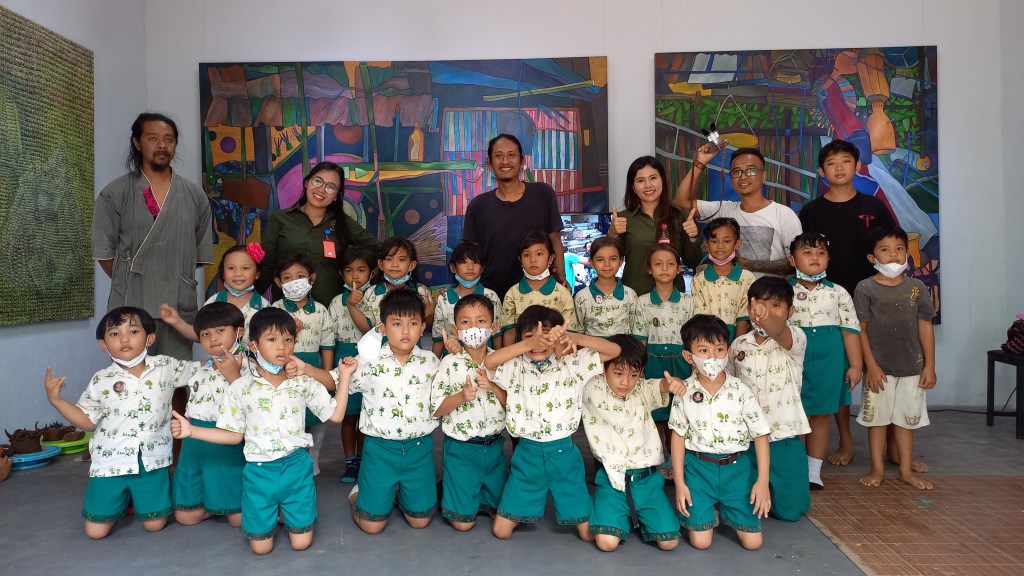
Members of KSGR with teachers and junior students of a local school
The famous Pita Maha Artist’s Association was established in Ubud in 1936 to oversee the development of this new art. The creative epicenters were in Batuan, Klungkung, Ubud and Sanur which already had distinct traditions. The Pita Maha was dedicated to maintaining the highest artistic standards and conducting exhibitions nationally and abroad. The Pita Maha dissolved in 1942, yet the village styles continued, and other genes have since evolved.
The next era of collectives began with Sanggar Dewata Indonesia (Workshop of the Gods). The turning point, in 1970, was a small group of radical art students studying in Yogyakarta under the pioneering Balinese modernist Nyoman Gunarsa (1944-2017). Their experimentations with iconography and philosophies mixed with western ideas forged an exciting new language of Balinese contemporary art. Many collectives have been established in the past five decades, including groups for women artists. However, some groups were short-lived, while others were frequently inactive due to cultural responsibilities placing great demands upon the artist’s time.
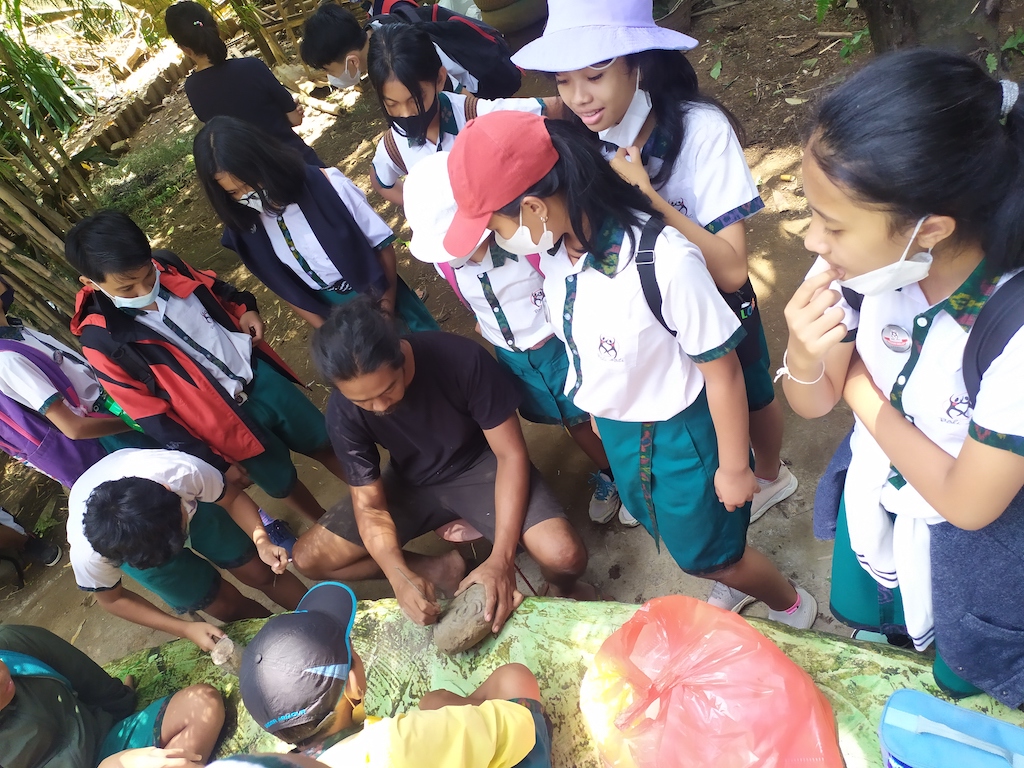
KSGR co-founder Rio Saren with students from Bali Hati School
Tourism boomed during the 1970s through the beginning of the new millennium and artists enjoyed increasing economic success. In addition, the Internet and digital peer-to-peer platforms created more significant opportunities to access the growing national and international market. All the while, artist collectives were valuable forums of discussion and activities. However, with the 2020 global pandemic, tourism closure, and the dramatic downturn in the local and world economy, Balinese artists were confronted by the most significant crisis.
Kelompok Seni Gotong Royong (KSGR) is a landmark, new artist collective established in response to a new economic paradigm. KSGR reignites past ideas and wisdom as solutions to forge new pathways into an uncertain future. Their name is derived from the tradition of communal sharing known as Gotong Royong.
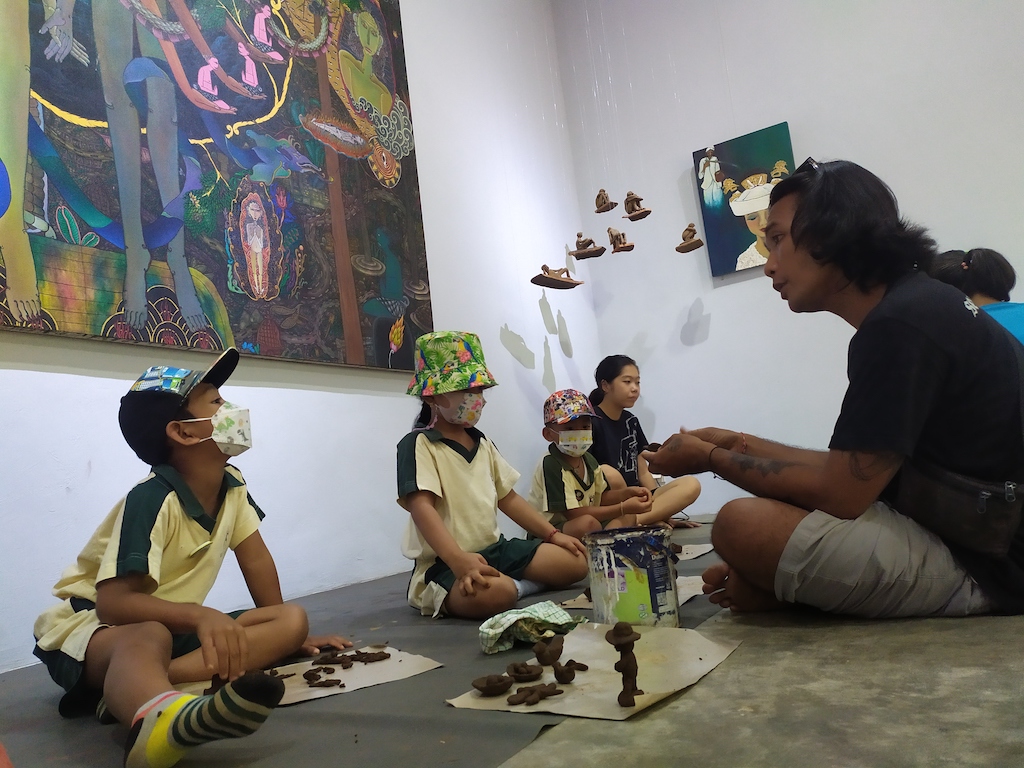
A member of KSGR facilitates a terracotta workshop with school student
“There was anxiety among many artists about how they and their families could survive during this economic decline. These concerns became the basis for establishing a new collective,” said KSGR co-founder Rio Saren who graduated from the Indonesian Art Institute (ISI) Denpasar in 2008. “Our discussions focus upon understanding our potential and how we may thrive into the future. However, because our current circumstances are so unusual, it is necessary to change our mindset. So, we began by removing excessive artistic idealism that is often prevalent in discussions and addressed the challenge of generating an income so we may eat. And be grateful for doing so.”
“The development of the commercial art world during the past century has led to art becoming too exclusive and political where limited numbers of artists achieve success. Therefore, we readdressed our art practices focusing on what has been lost from our culture due to modernity,” Rio explained. “Sustainability and cultural regeneration are essential to KSGR. We seek to discover new forms of value creation inspired by our heritage. During an era where our traditions are increasingly vulnerable, it is significant that our solutions be derived from the past.”

A terracotta creation made by a child during a KSGR workshop
KSGR is open to any artist to participate and focuses on two avenues. The first aims to generate a sustainable income by producing functional, one-of-a-kind artisan products. The majority of materials for these products are sourced from nature, making them cost-effective. Rio tells me that sourcing materials are an exercise and activity for the spirit, body, and mind. Inspired by the Balinese Banjar village administration system, KSGR’s communal space, Pintu Saren Art Space, is located in Banjar Saren Sibangkaja, Abiansemal, Badung. The collective has recently built two new studios and a multi-purpose space functioning as a display venue at the rear of Rio’s family compound.
Some of the items produced are stone planters with cactus, the stones an abundant source from the local river beds. Unbreakable pots painted in vibrant decorative designs; the pots are made from fabric scraps and a thin layer of concrete, being light and strong. Other decorative items are made from driftwood and local clay. The clay items are fired in a traditional kiln; the techniques follow old Balinese methods of earthenware.

A terracotta creation made by a child during a KSGR workshop
“One of KSGR’s main activities is to gather each Sunday and explore art, accompanied by cooking and sharing food as a form of gratitude to the universe. Through food, we may continue to survive and sustain our creative activities.” In addition, the gathering is a supportive environment for the members to share ideas not only directly related to the group yet about their practice conducted in their home studios. The personal focus is on being creative and not making money.
“An outcome of our discussions is the Garam Dapur Project (Salt Kitchen),” Rio told me, adding, “We adopt salt as an analogy. It is meticulous as a symbol of abundance and among the spices essential to each dish. While the kitchen is an open creative space for preparing food.”
The objective of Garam Dapur is to initiate an art space for community activities focused on learning and experimentation, and exhibitions. “Since February this year, we have held art and craft classes open to children and adults every Sunday. Each with a different theme, such as mask and sculpture-making from clay or stone carving. We are also conducting classes for schools and hands-on learning with junior students. For example, KSGR has collaborated with Bali Hati School and 3-to-5-year-olds in the Seva Karuna Study Group.”

Garam Dapur community art space at Pintu Saren Art Space, located in Banjar Saren Sibangkaja, Abiansemal, Badung
”The classes for local children and adults are becoming popular and are a lot of fun. It’s not about the outcome but more about how to feel. There are no mistakes when the creativity is honest and pure,” Rio said. The participants learn directly with the KSGR artists, and the program concludes with the sharing of traditional Balinese food. Classes are offered in exchange for a donation.
“The children and adults are serious and focused when working. We teach them the techniques and encourage them to utilize their full imagination. We love seeing the results. Imagination and creativity enrich people’s lives and are often very helpful, even if these people do not follow the artistic path,” Rio’s wife Sumie, an artist and mother of two, stated. “Our activities make a significant cultural contribution. Especially when we see kids who want to play games on their cell phones, forget their digital distractions, and concentrate on learning and being creative.”
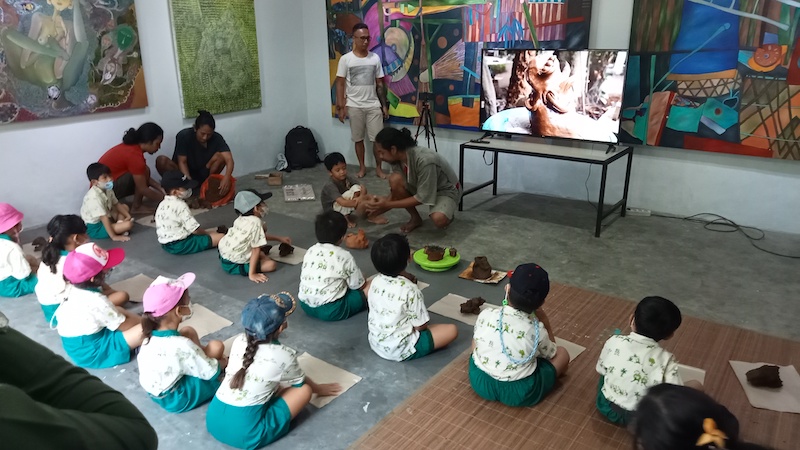
KSGR co-founder Rio Saren and Edy Asmara with students from Bali Hati School
Thinking outside of the box – seeking innovation and change – is a prerequisite to growth. When circumstances become dire, our creative faculties come to the fore. Unfortunately, the challenges of making art for the market inhibit creativity. Therefore, KSGR engages in a fresh approach, referencing cultural fundamentals. By composing an alternative space to address the current situation while offering new individual empowerment for their studio practice. This progressive strategy is good news and will continue to yield positive results.
Instagram @ garamdapur_project
Words: Richard Horstman
Images courtesy of KSGR
No part of the written content of this website may be copied or reproduced in any form, along with article links uploaded to other websites, for any commercial purposes without the written permission of the author. Copyright 2020
 life as art asia