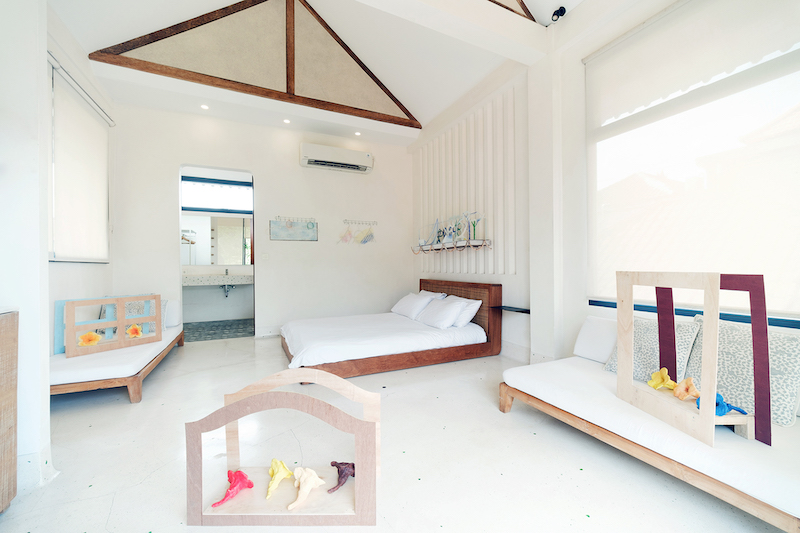
One of the secrets to successfully conveying artistic ideas to an audience is the artist’s ability to economise their visual design language. “Less is more” is a creative philosophy that emphasises the value of austerity and minimalism. By reducing unnecessary elements in a composition, the artist can achieve greater clarity and effectiveness in communication.
One of the features of “Heaven and Earth and Ten Thousand Things are One” 2025, a wall-mounted site-specific installation by Indonesian contemporary artist Oshi Naryose, is its design simplicity. The 140 x 50 x H 45 cm work, made from iron plate, metal, paint, and wood, is displayed in Project Etere’s Penestanan, Ubud apartment. At a glance, the piece seems to defy imagination. Looking more closely, however, the work can be deconstructed and reassembled, allowing it to “open up” and reveal its symbolic elements and meaning.
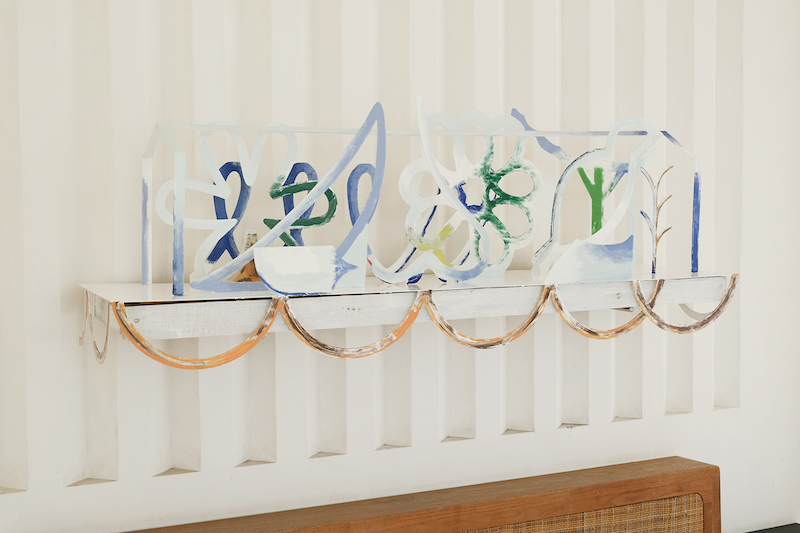
“Heaven and Earth and Ten Thousand Things are One” 2025 -Ohsi Naryose
A curious arrangement of singular colourful items greets the eye. Organic curves and arches juxtaposed against rigid straight lines and flat surfaces merge together into a myriad of joyful movement and visual delights. “Heaven and Earth and Ten Thousand Things are One” is one of many thought-provoking two- and three-dimensional works by Naryose on display in DERAU dan KEMARAU (Noise and Drought) 14–15 March 2026.
“The exhibition title Noise and Drought emerged from a personal condition that became both the foundation of my practice and the lens through which I responded to reality at that time,” Oshi Haryose told NOW!Bali Magazine. “I deliberately positioned myself in a state of drought -a condition of scarcity and dryness – in order to become more sensitive and precise in perceiving reality in its fullest form.”
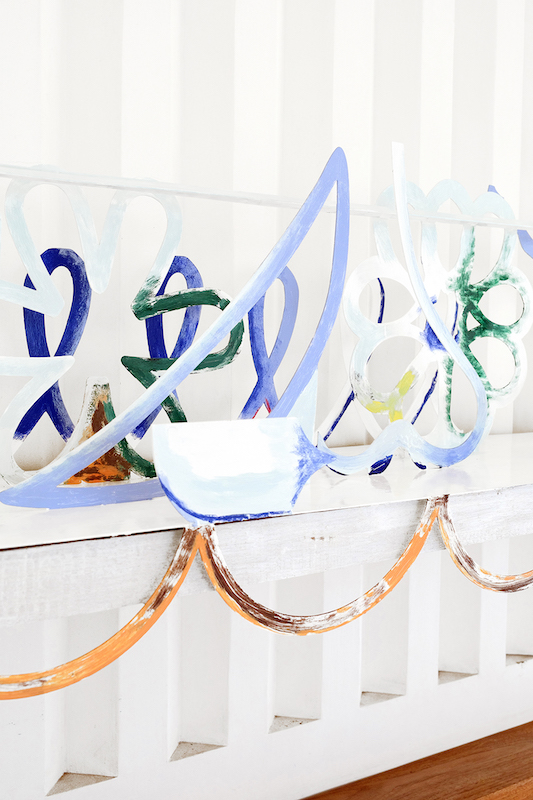
Detail of “Heaven and Earth and Ten Thousand Things are One” 2025 -Ohsi Naryose
“By reality, I do not only mean what can be touched or clearly identified, but also what often escapes language: illusions, meaningless sounds, inaccessible spaces, absences, and countless other phenomena that exist beyond direct articulation,” Naryose said. “In receiving this ‘noise’ (derau), I hope to encounter reality as a whole, with all of its layers and complexities intact. By placing myself in the position of cracked and parched soil, I imagined that whatever rain might arrive could be absorbed immediately, without being filtered through the limitations of language or pre-existing interpretation.”
“Heaven and Earth and Ten Thousand Things are One” is inspired by the Balinese sanggah, a family or community shrine for prayer and offerings. Naryose’s studio in Gianyar is situated beside a temple, immersing him in the sensorial dimensions that distinguish Balinese ceremonies: sound, smell, structures, colour, and movement. His multidisciplinary practice is conceptually grounded, imbued with local elements, ready-made items, and what he calls ‘poor’ material. DERAU dan KEMARAU presents mixed-media works in clay, metal, iron, wood, and stone, as well as coloured-pencil drawings on paper, all set across two domestic locations in Penestanan.
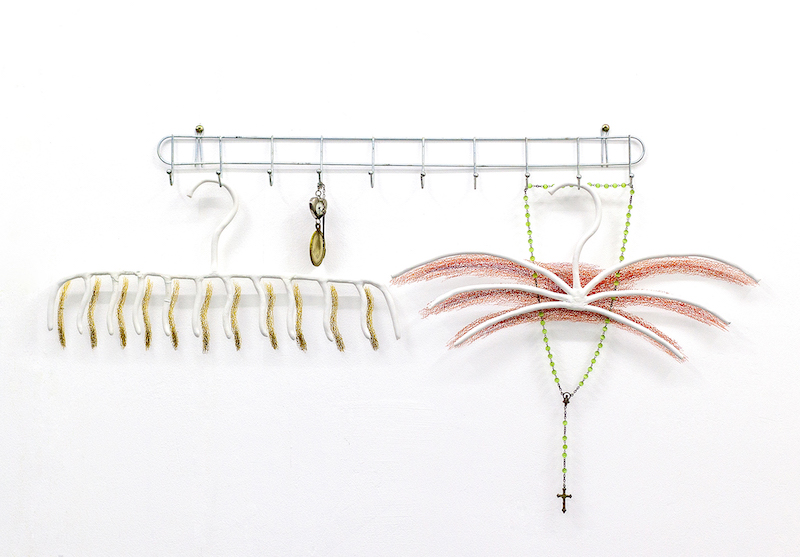
Clay and found objects installation by Oshi Naryose.
Colourful, linear shapes: tree trunks, flowers, a half moon, a bird, an oversized nose, and other nondescript icons forged from steel, housed within a structure of four legs and two connecting beams with gable ends, distinguish “Heaven and Earth and Ten Thousand Things are One”. “I translate the inspiration and energy of the sanggah in an unusual and direct way. A flower, a bird, a half moon, the Balinese calendar and the moon relationship. A nose to smell the incense. I imagine the sanggah and the Balinese way of living in a structural way,” Oshi said.
“I absorb daily life experiences, attempting to fully engage all of my senses; when there is a sound, I take the sound, when there is a smell, I take that also. I try to bypass my thinking, seeking to find the essence of what I have grasped. I then allow this to influence my studio practise,” said Oshi, who was born in 1990 in Semerang, Central Java, resided in Jakarta, before relocating to Bali in order to discover a new creative perspective.
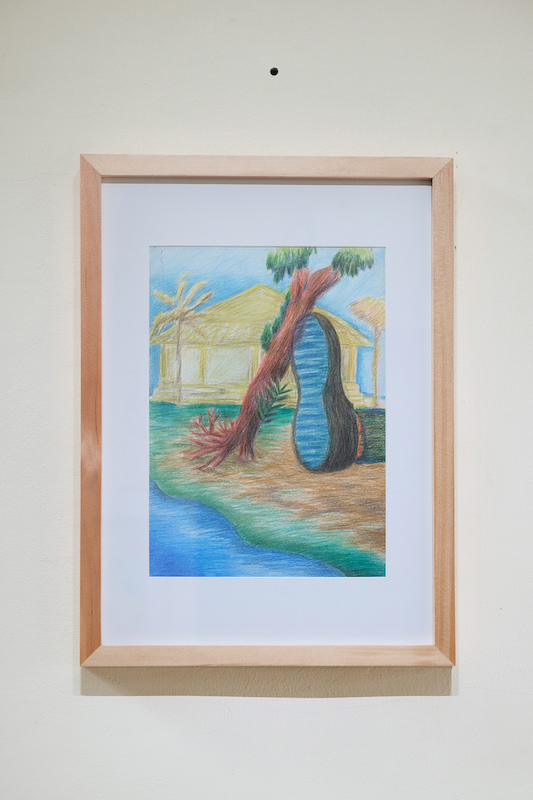
Coloured pencil drawing on paper by Oshi Naryose.
was invited to participate and exhibit in an artist-in-residency program presented by the international art project Lucie Fontaine, which has previously hosted events in Prague, Stockholm, Miami, and New York, as well as the Bali artist-in-residency program Project Etere. Kayu is Lucie Fontaine’s branch in Bali and an expansion of Bali-based Italian artist Marco Cassani’s artistic practice.
The ongoing decade-long series at Kayu, entitled “Domesticity,” investigates the relationship—or lack thereof—between contemporary art and domestic spaces. Conceived as ‘social sculptures’ in the form of exhibitions and performances, it features collaborations with Indonesian and international artists. Through these collaborations, the series reflects on art as a tool for socialising and re-evaluating the territory, the population, and society as a whole. A domestic aspect of Naryose’s practice attracted Cassani to collaborate in Project Etere.
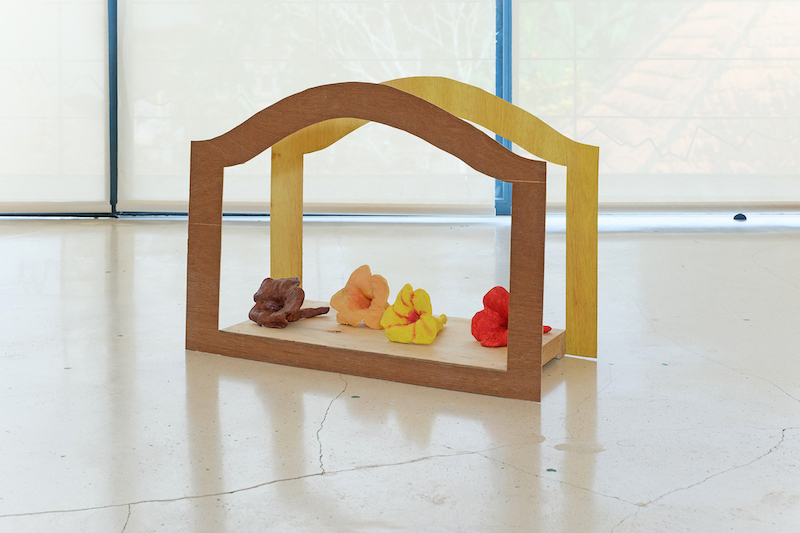
Installation by Oshi Naryose.
drawings enlighten living rooms, bedrooms and bathrooms throughout the two exhibition spaces. In his autobiographical, self-reflective expressions, his style has developed over many years. The pictorial dialogue is intimate, calm and naïve, enhanced by his economy of visual information. The drawings function to liberate him from the self and childhood memories. Some reveal a great depth of being.
With two distinct aspects, Naryose’s drawings are categorised by portraits and mindscapes. His portraits are not close-up references but snapshots from afar, capturing an intimate, serene essence of his subjects. Architectural structures appear as consistent themes in his drawings. Windows are often a feature allowing varying viewpoints into a space enriched by symbolic objects.
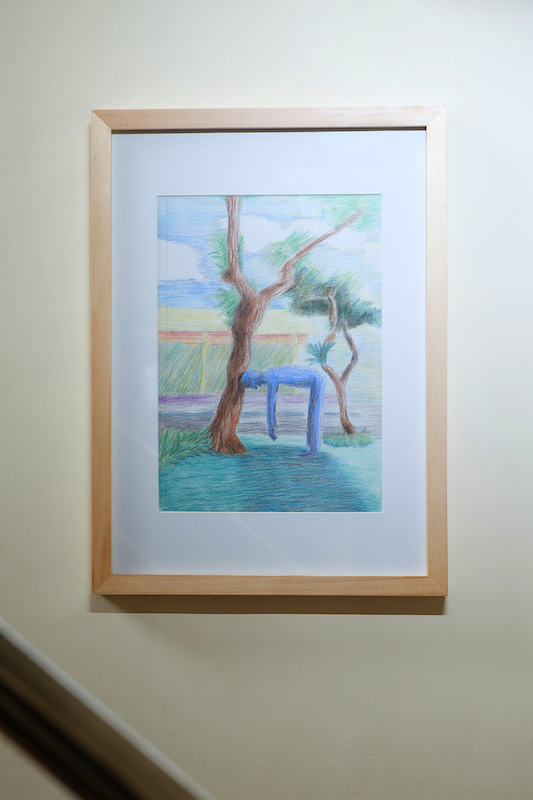
Drawing on paper by Oshi Naryose exhibited in Derau dan Kemarau.
I have an expansive imagination, and my ideas are layered and dynamic. I studied sculpture, though I did not complete my formal training. My drawings are both a home for my ideas and the place where they begin to grow,” Naryose confessed. “I use coloured pencils because they give me a sense of confidence and freedom of expression. It is a medium I have worked with since childhood.”
Kayu, presented by Lucie Fontaine, contributes to the development and awareness of the international contemporary art discourse in Indonesia by organising experimental and conceptual projects. Kayu enhances the local contemporary art scene by offering an alternative artist-run space, establishing innovative ways to work with artists, and validating and elevating the practice of contemporary art in Bali.
Instagram:
@oshinaryose
@project.etere
@kayuluciefontaine
Words: Richard Horstman
Images courtesy of Project Etere & Kayu Lucie Fontaine
 life as art asia