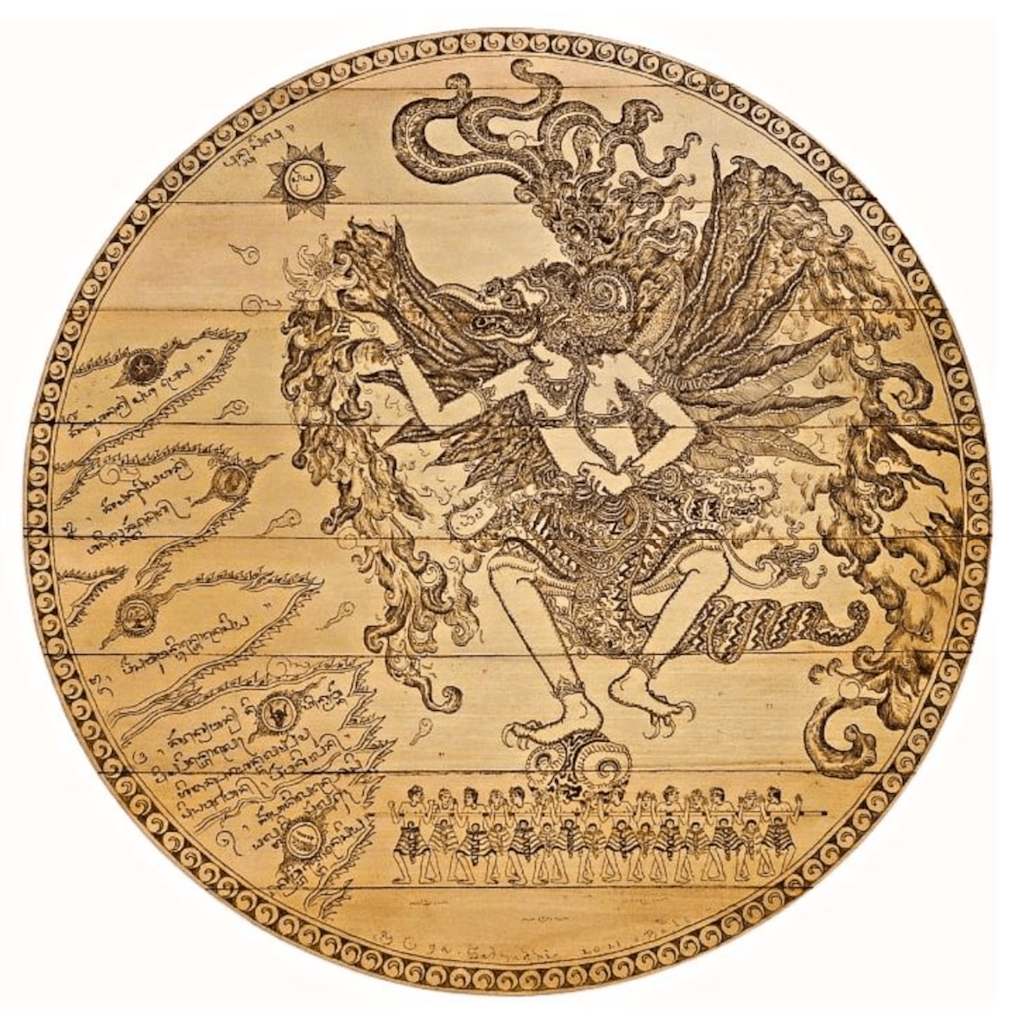
Dating back to the 16th-century, the tradition of scribing leaves with cultural knowledge compiled into lontar manuscripts is undergoing an exciting new illustrative era driven by the emerging generations of contemporary artists.
The Balinese Lontar are manuscripts crafted from the dried and processed, pale beige-colored leaves of the Rontal palm (Barasus Flabellifer). Strong and flexible with a fibrous grain the length of the foliage, the leaves’ have various applications. The technic of scribing minute information onto pages measuring about twenty-five centimetres long requires perfect vision, a steady hand and determination. The pangrupak is a sharp metal instrument with a wooden handle to inscribe fine graphic lines.
The aesthetic effect is achieved with the black dye from the Hazelnut rubbed along the leaf, with the excess wiped away, revealing the practitioner’s endeavours of script, symbols or illustrations. The vast array of Balinese religious and social content is classified as Weda – holy books, Agama – religious rules, laws, regulations, ethics and morals, Usada – homoeopathy and healing, Wariga – astronomy and astrology, Itahasa – epics including literature, Babad – history & genealogy, Lelampahan – the performing arts, Tantri – stories and notes and Prasi – illustrations.
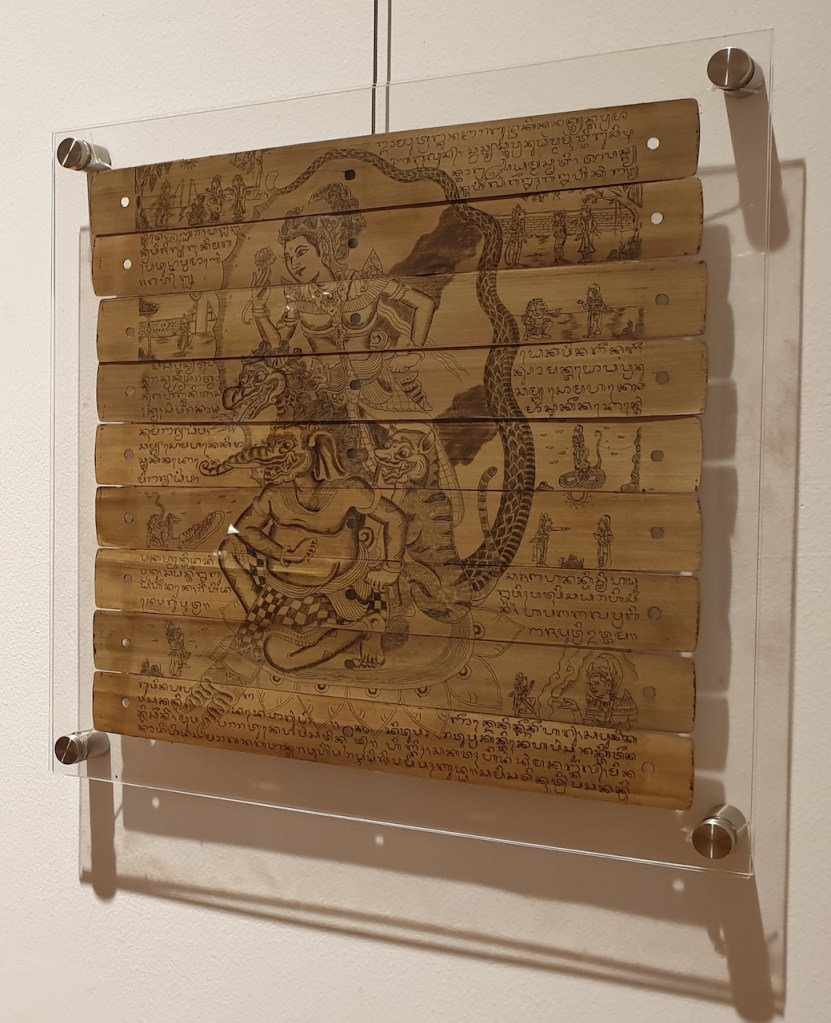
‘Sutasoma’ 2020 by Kadek Wiradinata. Prasi, 30x31cm.
A new generation of artists is currently breathing new life into prasi. In recent years, exhibitions have showcased works revealing fresh ingenuity. The classical presentation of Balinese narratives is still common. However, the medium is being explored in Japanese Manga influenced cartoon imagery, realism, simplified and naïve styles, and imaginative presentations. Committed to ongoing cultural development, the Cultural Office of the Provincial Bali Government presented ‘Prasara Prasikala Nukilan Taru Mahottama’. The exhibition featured prasi by sixty Balinese and Indonesian artists at the Bali Art Center, Denpasar, in February 2021.
One of the driving forces behind this outpouring is Oprasi Community, comprising students and alumni from UNDIKSHA University, Singaraja, North Bali. “The word operation inspires the name Oprasi. Therefore its members dissect and investigate the definition to explore potential with the visuals and presentation,” artist, writer, and Oprasi member Vincent Chandra told the Jakarta Post. Formed in 2018, Oprasi is a response to the introduction of the new subject Prasi Mologi into the UNDIKSHA curriculum in 2017. “There is a strong local history of prasi in Singaraja, therefore the subject has generated growing interest among the students,” he said. “Prasi is a drawing technique, yet slightly different. The key is to be patient and calm to avoid tearing the leaf.”

‘Opposite’ 2021 – Female artist Ema Kusumilawati presents prasi combined with brass plates. Lontar & Brass Plate. 33x53cm Image coutesy of Prasi Community
Two members of Oprasi recently had works selected in the ‘Bali Emerging Artists 2022 Exhibition’ running from 16 Apri l to 31 May at Sika Gallery, Ubud. Twenty-three-year-old Putu Dika Pratama began studying prasi in early 2020 and has quickly excelled. He presents three works in the form of locked wooden chests with prasi descriptions upon the lids. The illustrations are themed upon the historical background of the pre-Bali people of his village, Wongaya Gede, in a remote area of Tabanan, Central Bali.
‘Sang Patih’ is a composition of remarkable balance, form and narrative content. Upon a spiritual quest, the subject is depicted within a circle achieving perfect harmony with nature, sitting in meditation and receiving a download of sacred knowledge. “I use a locked chest as an analogy. The research data I discovered pointed to many mysteries yet to be revealed from this pre-Bali era,” Pratama told me. The intricate work, including research, took the artist two weeks to complete.

‘Sang Patih’ 2021 Putu Dika Pratama. Prasi & wooden chest 30×34.5cm Image courtesy of Vincent Chandras.
When I express myself through prasi there is a distinct satisfaction I experience unlike other art techniques,” Pratama said. “I value the creative interaction of Oprasi, it enables me to push the boundaries of my expression.”
One of the most experimental artists within Oprasi is Kadek Joning Prayoga. His 3-dimensional works merge engineering and artistic ideas. “I am especially interested in prasi because the materials and techniques are unique and outside of the contemporary art sphere,” said the UNDIKSHA graduate born in Lombok in 1998. “The incising technique was initially challenging for me until I learned the distinct character of leaf fibre.”
‘Mepliseran’ – meaning spinning, is an interactive work where Prayoga invites the audience to pull a lever up and down, propelling the motion of wings decorated with prasi. The artist has cleverly configured small bamboo pieces with strings as the mechanism mounted on a wooden framework. “The basis for developing my work is to change people’s perspectives. For example, the public believes that prasi seems to be related to the mystical, even though it is not always like that,” Prayoga said. “Oprasi is not rigid and stuck to the original principles of prasi. It is open to discussions, and the creative atmosphere is inclusive and dynamic. We feel free to share ideas, be open to insights and experimentation.”
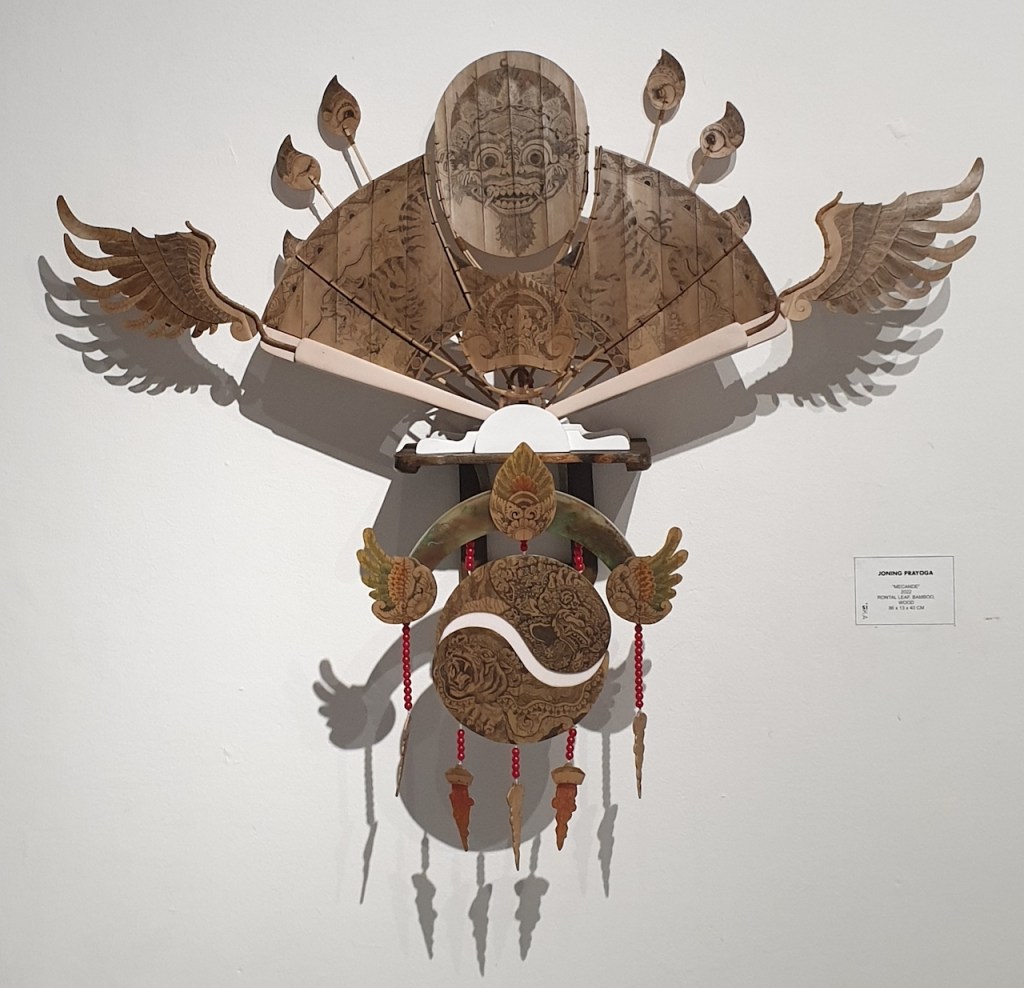
‘Mecande’ 2022 Joning Prayoga. Rontal leaf, bamboo, wood, 86x13x40cm.
The Oprasi movement is not just about preserving traditions and visual games or breaking existing conventions. Instead, we are constructing our own conventions and definitions of the practice,” said Chandra. He said Oprasi allows him the unique opportunity to stimulate other creative aspects within him, including working on collective works and installations. “Cultivating themes, visuals, discourses, and presentations are just a few methods beginning the Oprasi collective journey. Furthermore, the evolving prasi art and other genres will continue to talk about Balinese conventions because that is our art today. Creativity and awareness all go hand-in-hand.
The Balinese traditional art and crafts offer enormous potential for young creatives willing to explore. The development of Prasi, venturing beyond the classical expressions, is a refreshing aspect of the evolving local contemporary art scene, while contributing new value to the Balinese culture.

‘Cili’ 2020 Wayan Trisnayana. Prasi & acrylic paint. 35x20cm
Words: Richard Horstman
Images by Richard Horstman unless stated
Follow Richard on Instagram @lifeasartasia
No part of the written content of this website may be copied or reproduced in any form, along with article links uploaded to other websites, for any commercial purposes without the written permission of the author. Copyright 2023


Hi,
<
div>Wonderful artic
LikeLike