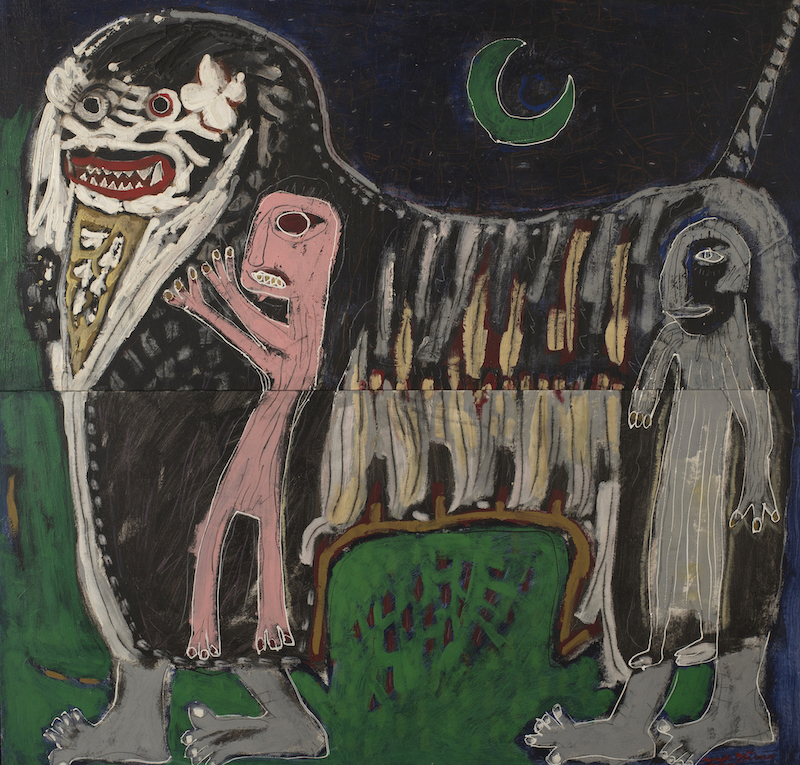
“My concern is to express reflections that go far deeper than what we can know with our panca indra (eyes, ears, nose, tongue and skin). All of my work is a process that goes hand in hand with the demands of my soul. It is essentially a spiritual process taking visible pictorial shape,” Made Djirna.
Lovers of Balinese art recently had the unique opportunity to see an exhibition of one of Indonesia’s contemporary masters, Made Djirna. MADE DJIRNA RETROSPECTIVE 1992-2022, opened on 18 December 2023 and continued until 7 January 2024 at ARMA Museum, Ubud.
The exhibition featured forty works, thirty-eight paintings and two wall installations spanning thirty years of a career that has consolidated the artist’s critical reputation nationally and internationally. While the artist has exhibited extensive bodies of work in Yogyakarta and Jakarta, this was the first opportunity for the local audience to explore part of Djirna’s vast oeuvre in a retrospective exposition spanning thirty years of his extraordinary career.
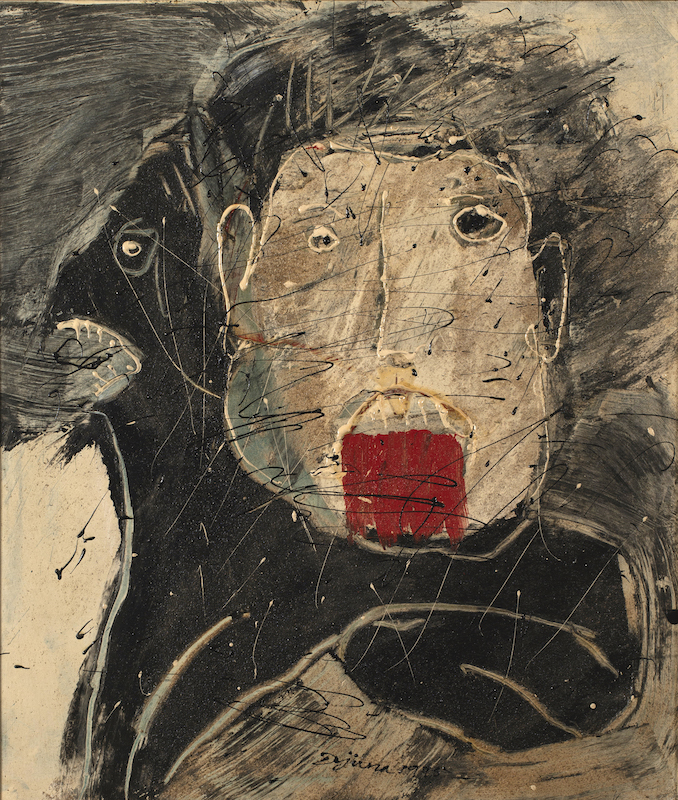
‘Melet’ 1995 – Made Djirna, Mixed media on canvas 70 x 60 cm
Highlighting the exhibition’s significance was the release of a 60-page book, ‘DJIRNA’, compiled by German curator Alexander Goetz. Including text by renowned Bali historian and art critic Jean Couteau and a pictorial essay photographed by Ted van der Hulst, the book deep dives into the private world of Djirna’s cavernous home studio in Kedewatan, Ubud. Rich in visual textures, colour and ambience, potent invisible forces merge within the studio, animating a portal into another time and space; mystery, delight and horror abound. For those unaware or others familiar with his name, to help fully appreciate Djirna’s talent, the book is a landmark expose, revealing insights into the inner machinations of this powerful creative force.
Born in 1957, Djirna’s formative years during the 1960s and 1970s witnessed tumultuous calamity and change. The ongoing eruptions of Mt. Agung lasted one year, 1963-64, followed by widespread famine and crop failure and then the communist purge in 1965, which accounted for the lives of an estimated 80,000 people in Bali. What he experienced marked a distinct coding upon his young psyche. Djirna’s introduction to painting was via the locally popular Young Artist’s style, a colourful, simplified modern Balinese art genre which achieved popularity during the second wave of tourism in Bali beginning in the 1970s.
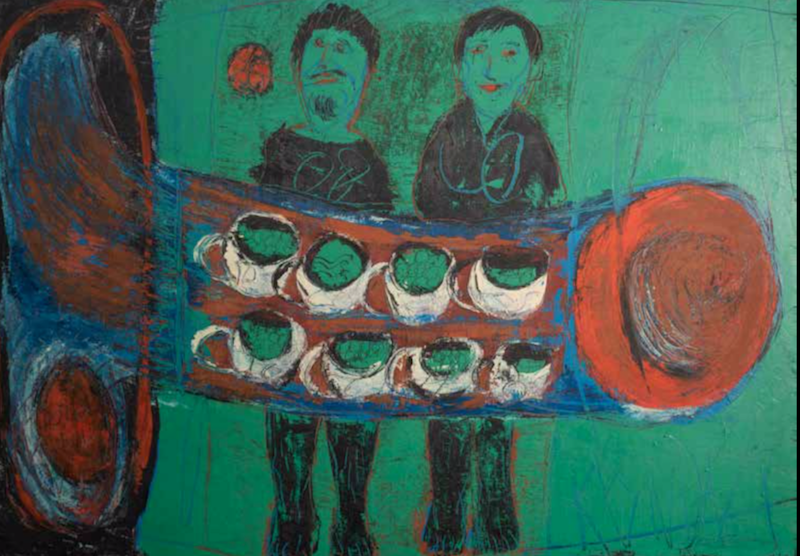
‘Untitled’ 2008 – Made Djirna, Mixed media on canvas, 140 x 200 cm
Djirna studied fine art at the Indonesian Institute of Art in Yogyakarta (ISI) from 1978 to 1985. Here, he lived for an extended period outside the psychological, physical and cultural restraints of rigorous village customs that emphasized the collective mindset. Evolving through the stages of youth into adulthood, being increasingly sensitized to the dualistic forces that impact upon humanity, Djirna would hone his initial signature style, describing the emotional human experience, a breakthrough in Balinese contemporary art. In 1993, he lived abroad as a participant in an International Exchange Programme in Basel, Switzerland, receiving critical acclaim while significantly impacting his cultural worldview.
Not for the faint-hearted, Djirna described the harsh realities of life in raw and earthy tones, forging ambiguous characters that blur the line between real and surreal, often revealing the darker angels of human nature and the invisible Balinese world of demons and ghouls. In contrast, however, he may depict the opposite, revealing playful human encounters. Djirna’s two and three-dimensional style ranges between primitive, naïve and abstract art. His themes explore an array of social and cultural politics in the local and universal spheres.
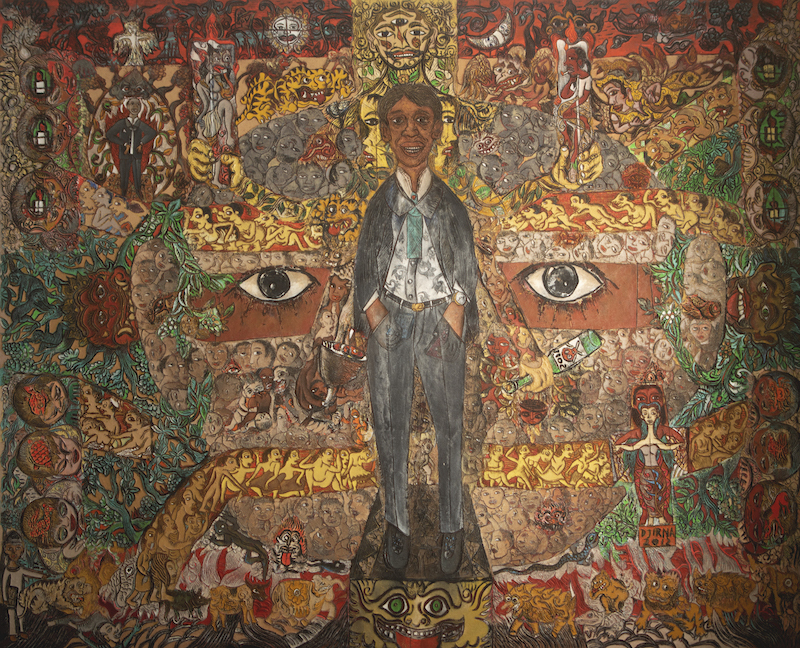
‘Untitled’ 2012 – Made Djirna, Mixed media on canvas, 260 x 360 cm
When not in his studio, the prolific artist scours beaches or the countryside, searching for inspiration, organic materials, and cultural artefacts that evolve into artworks. His installations within his vast labyrinth of a studio are out of left field. Huge, imposing collections of objects weaved together into sculptures and shrines that resonate with energy, simultaneously making them both intriguing and frightening. Pumice, stone carved from local rivers, volcanic rock, terracotta, coconut husks, bamboo, natural fibres and fabrics merge into spooky, imposing configurations, while an oil lamp flickers, representing a mysterious lifeform, invisible to the naked eye.
“Djirna expresses his inner battles, disconnected from the general references of the Balinese Hindu religion, in a visual style that eclipses others. He paints with a free spirit and interprets everything and anything in only his own way,” Alexander Goetz told NOW!Bali Magazine. “I was inspired to organize this project because retrospective exhibitions with books are unknown in Bali, and most artists cannot keep their older works. The exhibition is a non-commercial venture, mostly unheard of in Bali and distinguishes the artist from his contemporaries. This exhibition helps to elevate Bali’s contemporary art scene where it belongs, emphasizing the value of the cultural capital of the creative human spirit above all else.“

‘Untitled’ 2021 – Made Djirna, Mixed media on canvas, 150 x 100 cm
Soul mining to the depths of his spirit, striving to birth new life via his universe of ideas. Djirna constantly evolves, pushing the boundaries of his aesthetic style. While most remain stagnant within their commercially viable brand, Made Djirna is a genuinely authentic artist relentlessly seeking new frontiers.
Words: Richard Horstman
Images courtesy of Alexander Goetz and Ted van der Hulst
Follow Richard on Instagram: @ lifeasartasia
*Author’s note: No part of the written content of this website may be copied or reproduced in any form, along with article links uploaded to other websites, for any commercial purposes without the written permission of the author. Copyright 2024
 life as art asia