AI and 3D printing technology offers Jemana Murti vast horizons for artistic development. Emerging Balinese artist Jemana Murti has embarked on a distinct creative mission, anchored securely within his traditions while propelling him on an exciting trajectory and original art frontiers.
Majoring in Fine Art at the Nanyang Academy of Fine Art in Singapore one of the subjects Murti studied during his four years at college was New Media Art. The genre includes digital art, interactive art, internet art, virtual art, art made using AI, robotics, video games, biotechnology, 3D printing, computer animation; any form of contemporary art created using new technology. The subject ignited his already growing fascination for technology and the AI culture, and how to empower his ideas and develop his practice with hi-tech digital tools.
After returning to Bali in 2020 after four years in Singapore, along with vacations abroad, Murti had become progressively sensitized to the vulnerabilities of his culture. One of many questions he contemplated was, “What if the Balinese no longer honoured their responsibility as traditional custodians maintaining their culture? What would happen if we bestowed this obligation upon machines?” He especially laments the sale of cultural icons. This puzzle has inspired a fresh chapter in his innovative adventure.

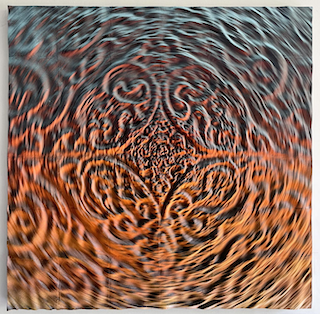
Jemana Murti and Phantasma, 2022.
Murti’s interest in the computer science phenomenon of Artificial Intelligence, intelligence demonstrated by machines, as opposed to human intelligence, led him to discover Midjourney, a popular online learning program, early in 2022. When provided a list of words, the program reviews the terms, finds related pictures on the Internet, and finally formulates corresponding images. Fascinated with this methodology, Murti believed the program to be a system of how machines may comprehend and interpret culture.
Last August, he began experimenting with the program linked with 3D printers to create prototype contemporary artworks. He started by feeding Midjourney the words “Balinese carvings”, to which it responded with an array of images. The outcome is ‘Ghosts of the Future’, his first series of works, wall pieces and sculptures that fuse technology with Balinese culture.
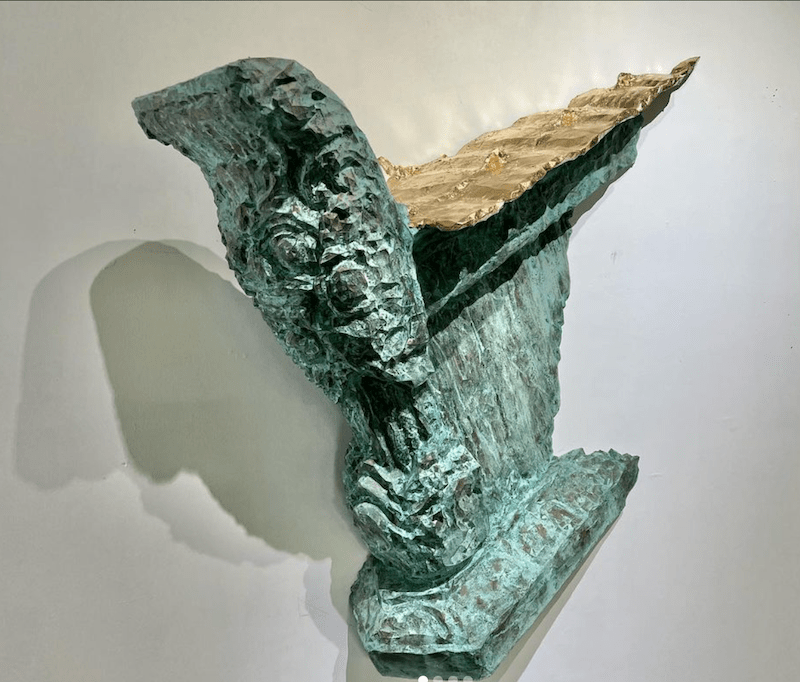
‘Future Relic Gamelan’ 2022 – Jemana Murti. Copper particles gold leaf 3D printed PETG, dimensions variable.
Initial prototypes works are printed with bio-plastic Polylactic Acid derived from sustainable sources of fermented sugar cane, corn starch and cassava, Murti’s work ventures beyond conventional traditional natural media. Modern awareness continually seeks new possibilities responding to humanity’s increasingly dramatic ecological footprint. Tech innovations in developing natural resources allow Murti a distinct peace of mind by adopting alternative materials as his creative medium. His recent works are made from thermoplastic, a heat resistant and stronger medium.
Midjourney developed an array of images to which the printers respond, issuing 20 x 20 x 3 – 4 cm portions fastened together on aluminium frames creating ‘Phantom’, a 150 x 150 graphite black abstract composition with aesthetic similarities to Balinese traditional Patra floral designs. The 3D printing signature is angulated textures carved into plastic; Phantom appears as a dark yet intriguing underworld landscape. Murti has since completed numerous works within this series featuring differing design aesthetics and textured surfaces, coloured with an array of futuristic dynamic hues. His objective is to introduce unnatural colors to traditional carvings.
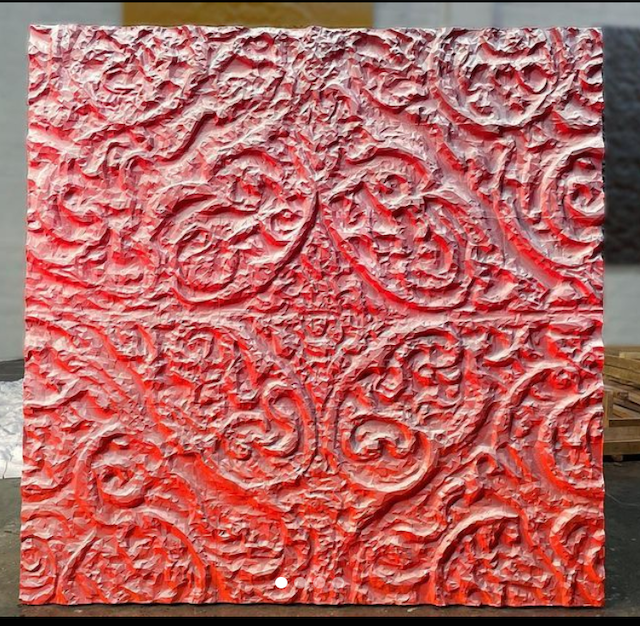
‘Vertices’ 2023 – Jemana Murti 3D printed PETG, acrylic on PVC and aluminium 120×120 cm.
“I like to think of ‘Ghosts of Future’ as a visual representation of what may happen if we get so lazy that we allow technology to do our job, including preserving the culture,” Murti told NOWBali Magazine. “I consider this series an antithesis of my culture. I’m doing everything we shouldn’t do when it comes to preserving the legacy of the Balinese people.”
‘Future Relic: Gamelan’ is Murti’s first sculpture within the series. The reproduction of a traditional gamelan musical instrument appears diagonally sliced in half, the surface embellished with copper particles and the keys in gold leaf. “It features a life-sized gamelan stuck between spaces. Like a ghost, it moves through walls, trying to position itself both as a physical artefact of our culture and as an object meant to be sold for money. Can it be both?” Murti muses. “The design is based on a 3D scan of existing gamelan sculptures. I edit the scans on the computer, then print it.” Making the sculptures offer Murti distinct challenges, needing to engineer the structures from 20 x 20 x 20 pieces.
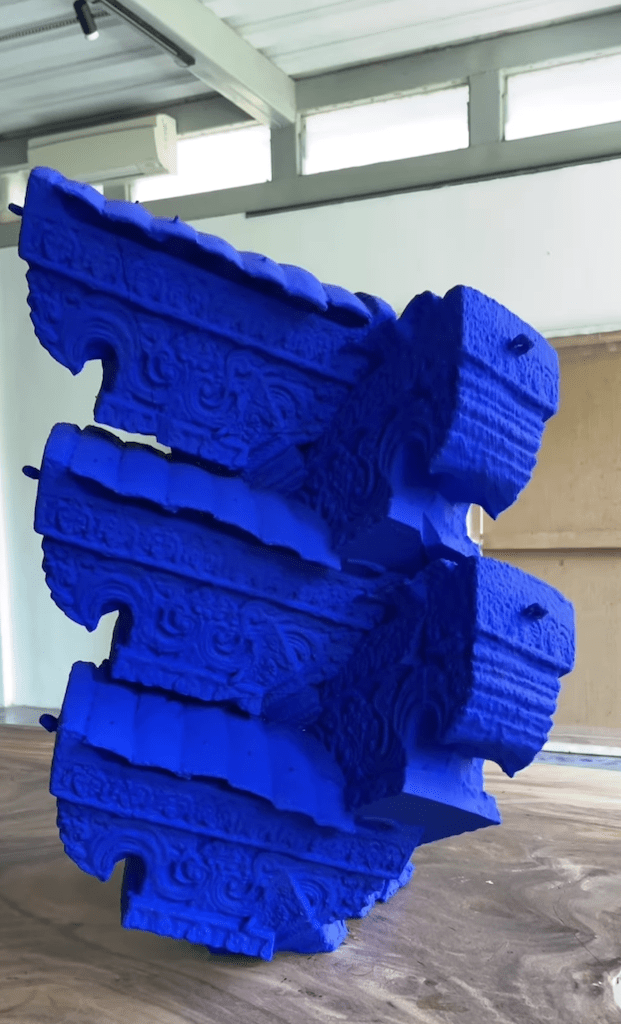
‘CTRL V (Blue)’ 2023 – Jemana Murti.
Murti’s sculpture ‘CTRL V (Blue) 2023, is a fascinating semi-abstract composition of angular portions of the gamelan pieced together and shrouded in a brilliant deep blue tone. “It is inspired by the effortless act of copy-pasting and comments on “traditional” cast resin and cement sculptures seen around Bali. It is also visually inspired by Polish-German international artist Aicja Kwade’s stacked iPhone sculpture and 20th-century pioneering modernist Constantin Brancusi’s Endless Column,” said Murti who was born in Denpasar in 1997 and first exhibited in Bali in 2012. “I see these 3D printed sculptures as a ghost phasing through walls or objects, implying that they are immaterial and in a way they don’t have a fixed status; can these objects still have a place in our culture? Or is it something so foreign that we exclude it altogether?
From woodcarving, Murti has progressed onto other cultural icons such as the Classical religious Kamasan paintings and textiles. “There’s automation everywhere, and if it generates more revenue, then traditional textile workers will use technology to make things easier. We already have machine-printed batik and endek. So I included textile patterns in this series. It’s also because Midjourney thinks the textile and carving patterns are the same, so it generated a 3D version of the textiles. What are some of the greatest challenges in developing these works? I asked him. “I have to produce hundreds of AI-generated images to make one artwork because some of the AI-generated images are so abstract that we simply don’t recognize them.”
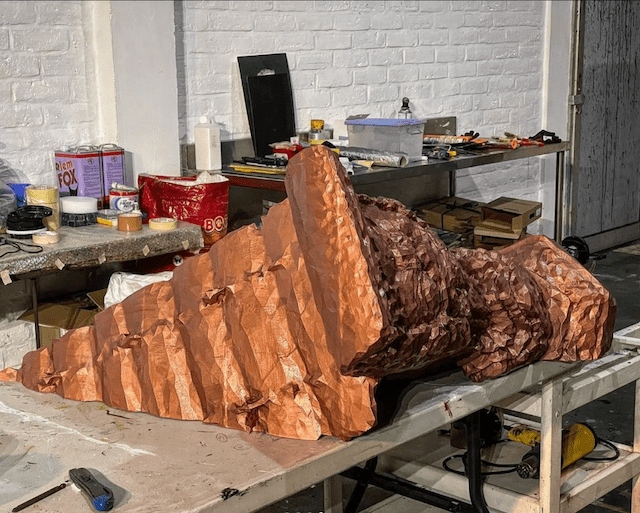
‘Future Relic Gamelan’ 2022 – Jemana Murti. Copper particles gold leaf 3D printed PETG, dimensions variable.
“One interesting thought that came to mind while working on this series. I sometimes see these works as similar to report cards. If we saw our grades and didn’t like them, we wish we could’ve done things differently. Same with these works, if we never monitor what people do to the culture with technology, we can only regret the things we didn’t do once it’s all gone.”
“I am striving for a new carving category,” Murti explained. ”A genre which defies the imagination, futuristic where the rules are yet to be defined. I wish to discover the limitations of carving; the hand and body are no longer the limits since the development of AI.”
Murti is one example of the exciting emerging local talent of an international standard that distinguishes Balinese contemporary art on the global stage. He is currently working towards his first solo exhibition, featuring wall pieces, sculptures and a few paintings, later this year at Gajah Gallery Yogyakarta.
Instagram: @jemanamurti
Words: Richard Horstman
Images courtesy of Jemana Murti
Follow Richard on Instagram: @ lifeasartasia
*Author’s note: No part of the written content of this website may be copied or reproduced in any form, along with article links uploaded to other websites, for any commercial purposes without the written permission of the author. Copyright 2024
 life as art asia