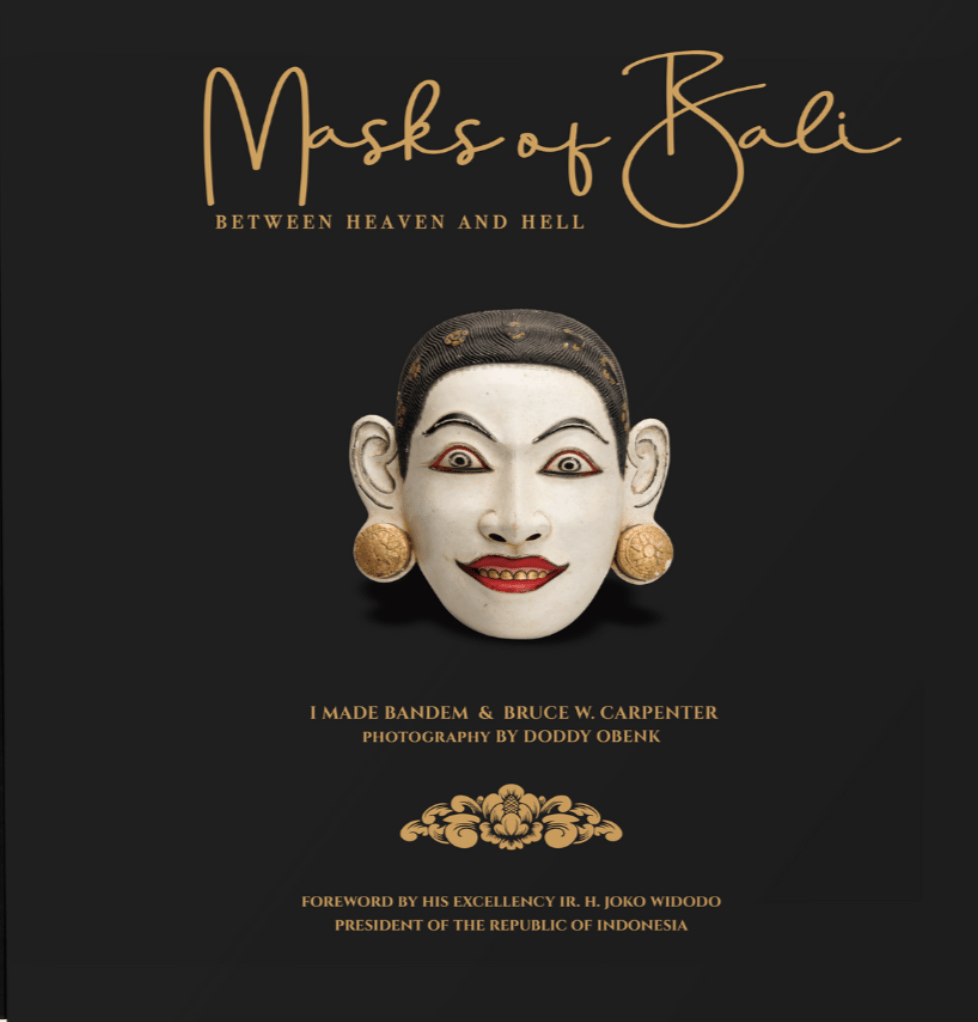
Balinese masks worn during ritual performances allow dancers to assume the disguise of humans, animals, spirits and powerful supernatural entities to help inform society about cultural ethics, morality, religious scriptures and folklore. The most comprehensive study about the cultural icon Masks of Bali: Between Heaven and Hell has recently been published.
Created according to sacred protocols, masks or topeng (meaning something pressed against the face) are recognized as living beings that receive unique offerings every 210 days. Exquisitely carved from the fine-grained white timber, mainly from the sacred Pulu tree, Hindu mythology recounts the tree as a manifestation of a drop of Siwa’s holy sperm. However, there is much confusion concerning what is and isn’t authentic traditional Balinese masks used for ritual theatrical means. This is especially true post-1970s with the introduction of foreign styles and hybrid creations in the mask-making epicentre of Mas village, Gianyar. One of the objectives of Masks of Bali: Between Heaven and Hell is to address this uncertainty and begin to set the story straight for future generations.
After more than four years of detective-like investigation and teamwork examining archives and collections worldwide, the luxury 612-page double volume was launched in Sanur, Bali 20 December 2022. Written by Balinese cultural authority and scholar I Made Bandem and American art historian Bruce W. Carpenter, this splendid documentation of the ancient art forms is richly illustrated with over 1000 colour images by photographer Doddy Obenk. A foreword by the President of the Indonesian Republic, Joko Widodo, distinguishes the book.

Prime Minister of the Majapahit Empire Gadjah Mada was responsible for the 1343 conquest of Bali. The mask is the property of Puri Agung Palace, Blahbatuh.
Volume One, 243 pages, is dedicated to informative knowledge beginning with a historical framework. In Masks of Gold, Masks of Wood, Carpenter’s essay examines historical and pictorial records proposing a map and chronology distinguishing Balinese mask dances into two eras, the first dates back to the Neolithic Period. The earliest known Balinese mask is from the Bronze Age (400 BC – 400 CE) and was discovered in West Bali. Tribal mask traditions of Indonesia date back thousands of years and provide the basis for comparisons with that of the Balinese.
The next period is after Hindu and Buddhist influences arrive in the archipelago, a part of a royal Pan-Asian tradition dating to the 7th century. Evidence confirms a sophisticated mask theatre in Bali from the 8th century. A double-page map illustrates the spread of the Hundu-Buddhist cultural influence throughout Asia and down into Indonesia. Carpenter notes, “Mask dances existed before the rise of the Hindu-Buddhist kingdoms but were recast in this period in new courtly surroundings as dramatic focal points.”
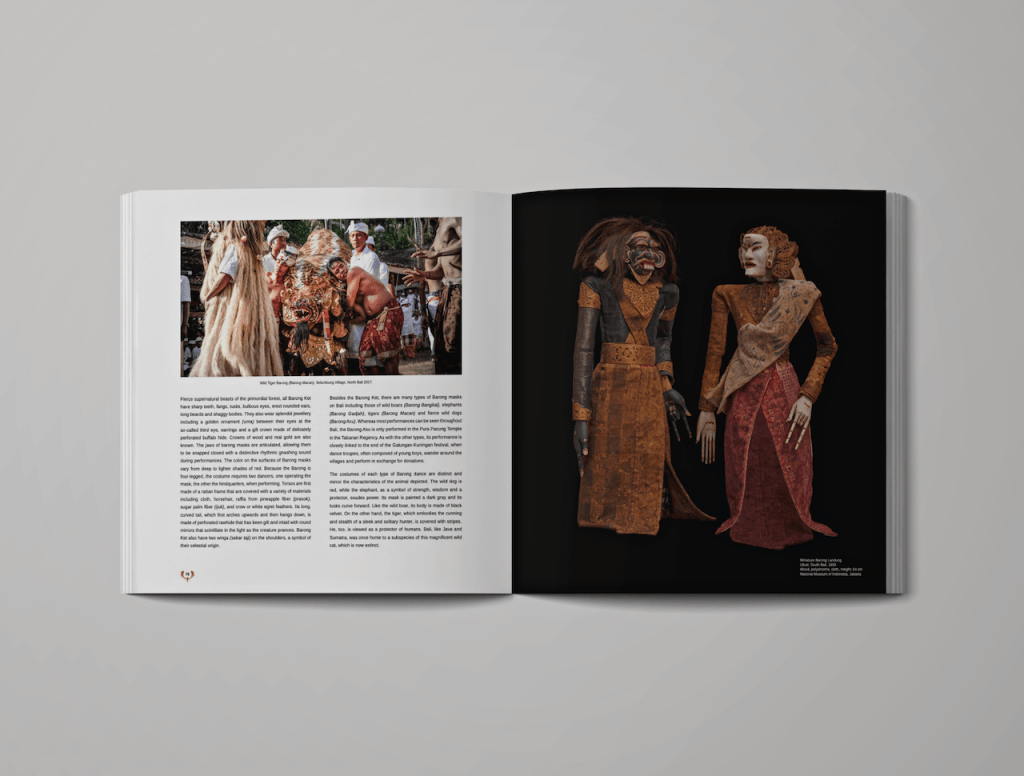
Author Made Bandem’s essay Living Balinese Mask Dances is devoted to the nine mask traditions that are distinguished by their iconography and function.
Living Balinese Mask Dances, Bandem’s leading essay, is devoted to traditional mask performances and dances. The nine masks traditions are distinguished by their iconography and function, including Topeng Brutuk, Barong, Barong Landung, Barong Dingkling, Wayang Wong, Topeng Ragnda, Topeng Bidadari, Topeng Babad and the oldest Topeng Gadja Mada. The first mention of mask dancing is within a 9th-century inscription. Masks have functioned ever since as ritual, historical, educational and spiritual objects while being viewed as a means of communication and popular entertainment.
“The Balinese also strongly believe that gods, ancestors and powerful nature spirits can act as bridges to achieve spiritual unity and higher consciousness. Masks and dance performances, which dramatize Balinese beliefs and religious life, are perceived as manifestations of these powers and aims,” writes the acclaimed third-generation dancer who obtained a PhD in Ethnomusicology at the Wesleyan University, Middletown, Connecticut, USA.
Essays The Inside I, II & III feature Tale of a Mask Dancer, a personal reflection by the author. Bandem’s extensive knowledge of mask performance stems from his father; I Made Keredek (1906-1979), a famous mask dancer and teacher who travelled the island performing and teaching. Making Sacred Masks desribes the creation processes, and Master Mask Makers & Dancers highlights fourteen celebrated figures. Finally, Topeng Gadja Mada describes how former Indonesian President Suharto burrowed masks from a Blahbatuh temple keeping them in Jakarta for three years to magically protect the country’s unity.
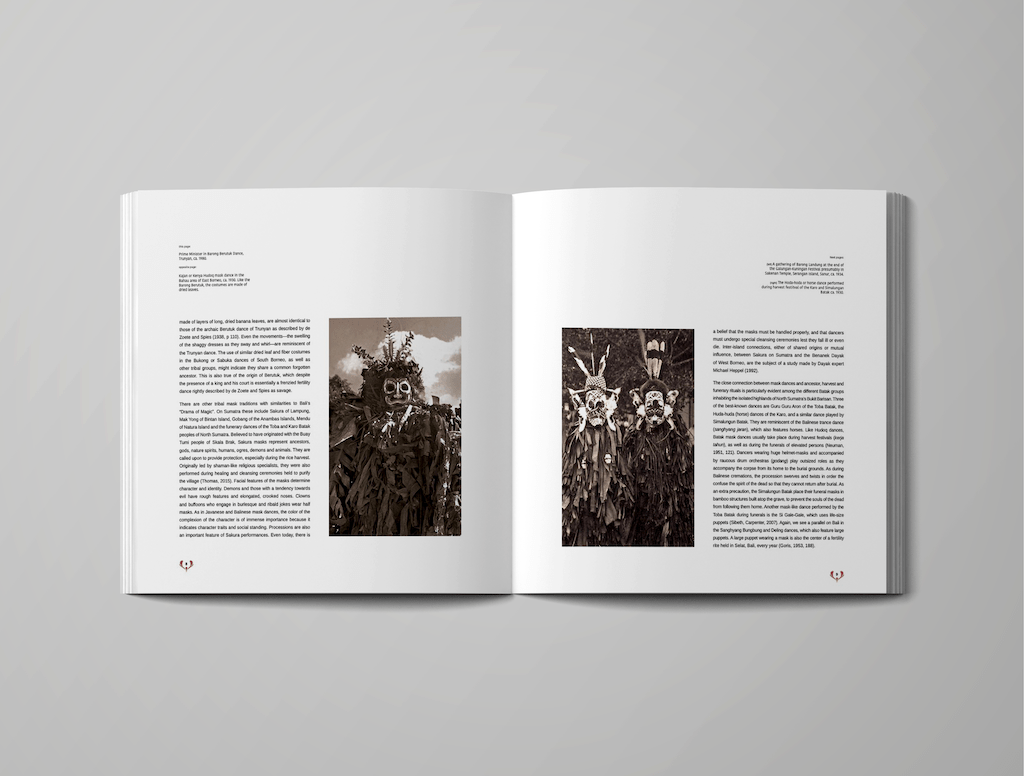
MASKS OF BALI Between Heaven and Hell features an investigation into sacred masks from rare dances never before photographed and the inclusion of scarce historical photos.
An essential aspect of the book comes to light via Bandem’s role as an activist, shifting our attention to the rapid loss of culture. “More than a century of tourism and modernization has also taken its toll.” He writes. “The biggest challenge to the maintenance and continuation of a strong mask dance theatre is the increasing number of dancers who have not undergone proper training, but nonetheless perform.”
An interesting fact that Bandem describes is that the dance Tari Lepas has evolved as a new performance style fusing random snippets and high points of many dances so audiences would not get bored. He notes, “The greatest threat to Balinese traditional culture and mask dances, however, is the rise of popular media.”
Volume Two is a 360-page gallery, a rich photographic essay of masks, dating back to the 17th century and earlier, yet mainly from the late 19th and the first half of the 20th century. The masks are sourced from museums, associations, temples, and public and private collections locally and internationally. In addition, there is an investigation into sacred masks from rare dances never before photographed and the inclusion of scarce historical photos.

A section of the gallery in Volume II of MASKS OF BALI Between Heaven and Hell, A Menagerie of Beasts & Demons
Masks of Bali: Between Heaven and Hell is a hefty and monumental production weighing seven kilograms. This entertaining read will inform scholars and those specialized in Balinese studies but also a general audience, including people interested in international performing arts, sculpture, Asian art and history. Published by Talisman Publishing, Singapore, in 2022 in a hardback slipcase, every attention to magnificent aesthetic detail is made by designer Ni Luh Ketut Sukarniasih.
Masks of Bali: Between Heaven and Hell
The book maybe ordered within Indonesia from www.masksofbali.com
and internationally from Amazon and Barnes and Noble.
Words: Richard Horstman
Images courtesy of Tapellestari
 life as art asia