
Informatively written, this superb photo essay and illustrated volume expands upon the limited current narrative, helping support the cultural development of the burgeoning Indonesian coffee industry.
The international coffee narrative and its stories that enrich the culture have, until recently, been dominated by coffee-consuming countries. These are primarily western nations, some former colonial powers. The one-sided, end-user perspective does not reveal the wonderful human stories that begin at the start of the supply chain. The accounts of struggle, overcoming adversity, innovations and passion. And significantly, the vital community relationships.
‘BALI COFFEE ORIGIN’S NEW WAVE’, authored by Rodney A. Glick and Michelle Anindya, is the first manuscript from the equatorial growing belt that explores the art of coffee production through the supply chain practices from the planting to the cup. Although processing coffee in Indonesia has only recently been recognized as a separate profession from coffee farming, what happens after has remained a mystery. Overflowing with information, this insightful document answers many questions and fills in the gaps. Its objective is to inspire fresh coffee conversations with a newfound knowledge base that seeks a brighter collective future.
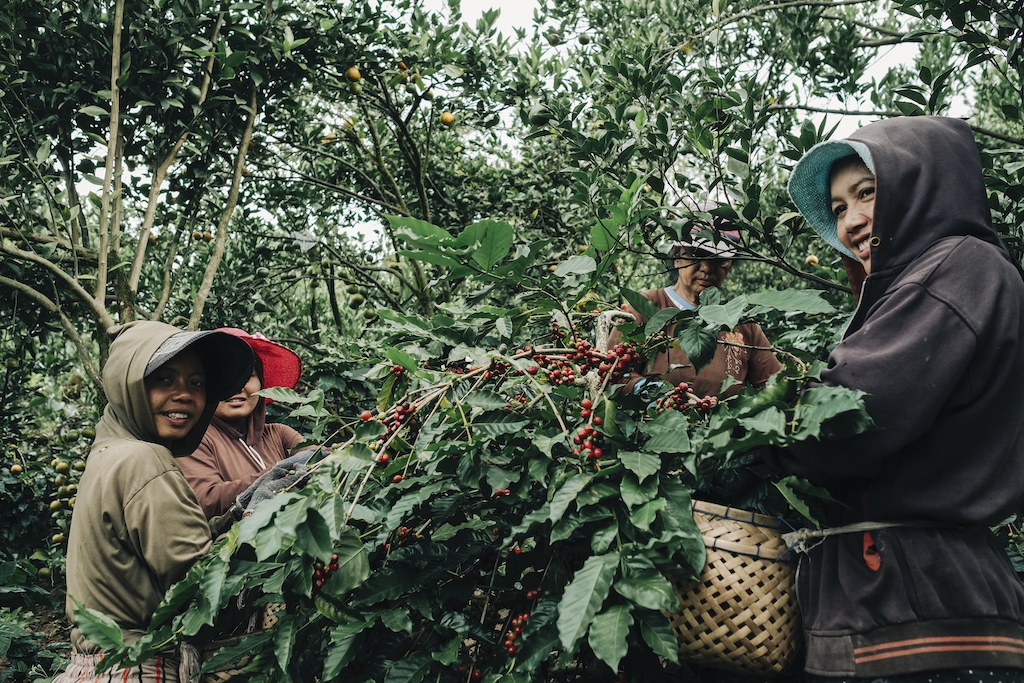
Coffee fruit picking in the Kintamani region of Bali. Image courtesy of Putu Wirasathya Darmaja
Published in hardcover in 2021 by Afterhours Books and edited by Julia Winterflood, ‘BALI COFFEE ORIGIN’S NEW WAVE’ celebrates the archipelago’s coffee culture. It features over two-hundred descriptive colour digital images by thirteen photographers, including Glick.
This window into the Bali coffee industry, from the growing and cultivation, experimentation with processing techniques to the roasting, brewing and serving, is nurtured by individuals and communities dedicated to the pursuit of better Indonesian coffee.
Twenty-plus pages of beautiful pictures lead the readers to a cultural and environmental overview. The book’s narrative then unfolds via chapters ‘Origin: A Place Where Coffee is Grown and Stories Unfold’ to ‘Our own Coffee Waves’, ‘Behind the Scene’, ‘Coffee Family’, ‘Flavor Begins at Origin’, Roda Rasa Kopi Indonesia’ ‘Kopi Zaman Now’ and concludes with ‘Introducing Singalong’ the bilingual magazine exploring Indonesian coffee through essays by young enthusiasts. The artistic layout and design are enriched by wonderfully illustrated neo-classical Balinese Kamasan figures describing different themes throughout the book.
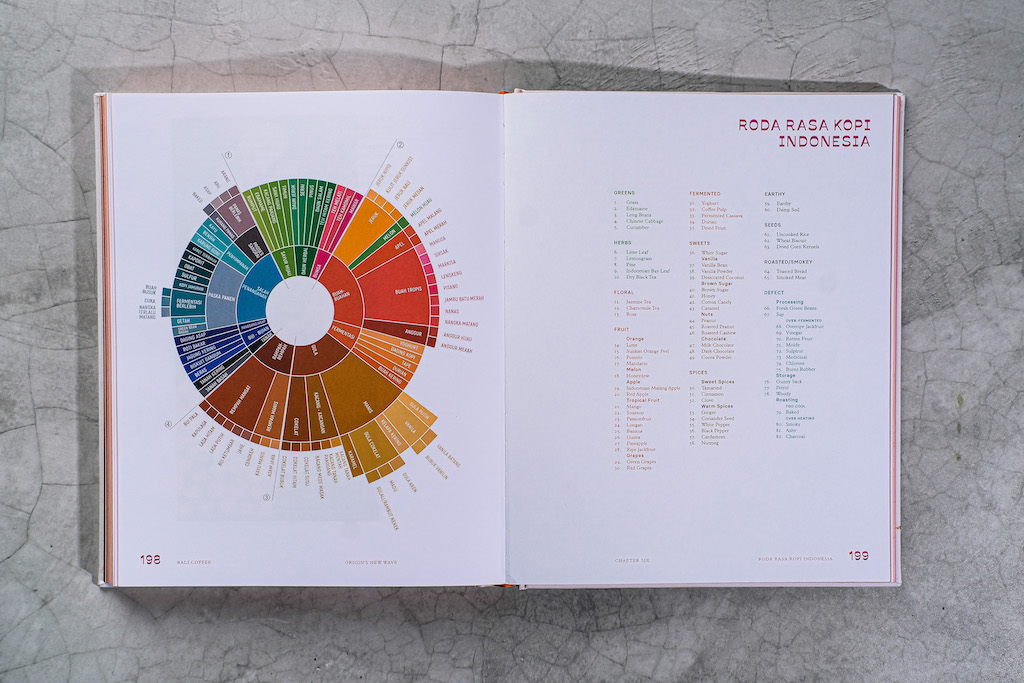
Roda Rasa Kopi Indonesia includes altitudes, varieties, flavour profiles, popular processing methods, speciality roasting options, commercial grade roasting options and roasting tips for single-origin filter coffee. Image courtesy of Ade Ardhana
Rodney A. Glick is an Australian born, international contemporary artist, coffee professional who has lived in Bali since 2005. As an outsider, he has been able to summarize the local scene objectively. His creative prowess formulates potent ideas. “When each stage of the coffee chain is interlinked, deeper dialogues can open up. I frame these dialogues as ‘The Architecture of Coffee’ to help me form tangible structures around the industry. These structures are often a poetic expression which encourages imaginative play that has practical outcomes.”
“Some of these outcomes are Seniman Industries (roastery, product design, workshops, and cafes) established in 2009; Karana Spesialis Kopi (farming, processing, and green bean trading) established in 2014; Singalong (online magazine exploring Indonesian coffee) established in 2017; and Roda Rasa Kopi Indonesia (Indonesian Coffee Flavour Wheel) released in 2019.” Glick writes in his opening essay.
“In coffee-consuming countries, retail brands, roasters, cafes, baristas and new technologies are the stars of the show. This is as deep into the coffee supply chain as customers can go to experience Origin stories.” the book states. Coffee waves are histories of distinct locales. Every coffee-producing and consuming country has its coffee waves. Now Indonesia has its resource book emphasizing the mounting wave energized by the past two decades in a revolution of coffee discovery.

I Kadek Edy’s Coffee Family. Image courtesy of Putu Wirasathya Darmaja
Agriculture is embedded in Balinese society playing a significant financial and cultural role within communities. Coffee farming is a family profession passed down through the generations. More than one crop is cultivated, the two most profitable being arabica coffee and several varieties of orange. Chapter Four, ‘Coffee Family,’ describes the transition from Balinese wood carving as the source of the family’s livelihood to roasting and brewing coffee.
“Younger generations move away from family compounds to cities for work. Tourism, hospitality and the coffee industry are big drawcards. Rural kids who grow up in wood carving communities transition to coffee-making easily.” “Baristas are the public face of the supply chain attracting young people to the industry, but farming, processing and roasting involve a physicality that is familiar to village life.” Each of the family members’ roles in coffee production is featured. At the same time, I Komang Suryana, who married into the family keeps the tradition of woodcarving alive, sculpting contemporary artworks. Photographed are some of his extraordinary coffee-inspired creations.
A Jakartan by origin, Michelle Anindya resides in Bali and has a degree in cultural studies from an American university. She is the editor of the online magazine Singalong. Anindya was instrumental in creating Roda Rasa Kopi Indonesia, released in 2019. Also, in developing the app and the Indonesian Sensory Lexicon, an accompanying aroma kit and digital cupping form. Indonesia is home to abundant tropical fruits providing countless references for coffee flavours and aromas. Roda Rasa Kopi Indonesia is dedicated to a remarkable feat of exploration, listing the local produce according to these flavours and aromas.
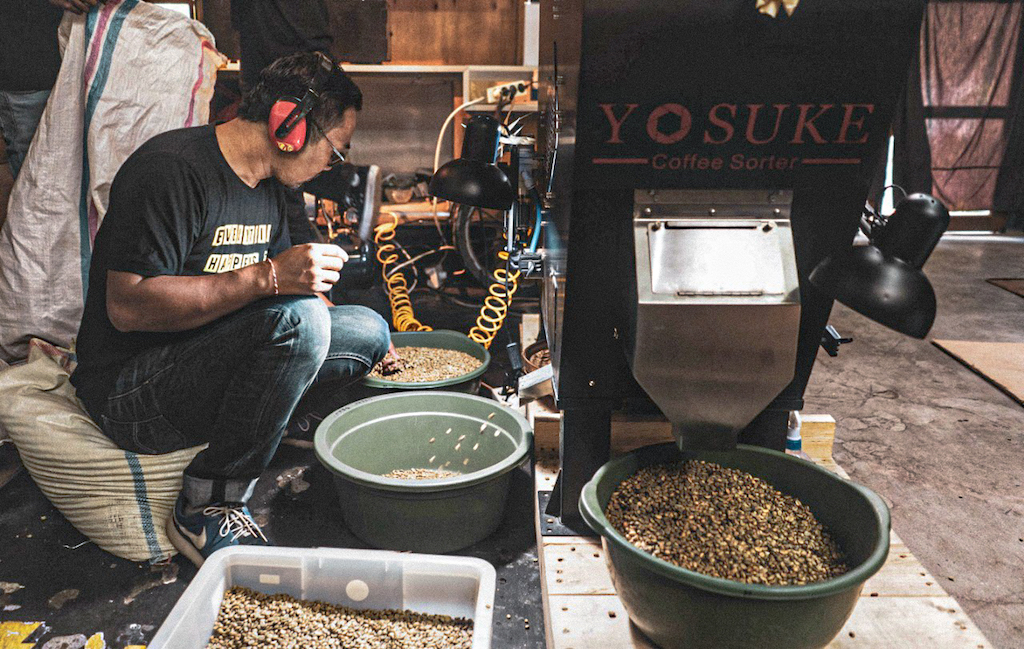
Green bean sorting. Image courtesy of Putu Wirasathya Darmaja
Highlighting interesting facts, a double-page table lists extensive data. This includes altitudes, varieties, flavour profiles, popular processing methods, speciality roasting options, commercial grade roasting options and roasting tips for single-origin filter coffee. This distinguishes the Indonesian Origins growing regions of Sumatra Aceh Gayo, West Java, Bali, Sulawesi Toraja, Central Flores and Papua.
While the book’s focal point focuses on I Kadek Edi’s family, it misses describing other wonderful stories from the many within the Bali coffee community. The farmers especially have interesting hands-in-the-dirt perspectives. Other creative processes also have not been described. The book falls short of exploring the many coffee varieties grown in Bali. At the same time, Robusta, the cheaper alternative, is only drawn into the text in the short essay ‘The Future of Indonesia’s Robusta’ in the final chapter. Authors face limits and must be discerning; interesting content has to be excluded.
‘BALI COFFEE ORIGIN’S NEW WAVE’ matches beautiful aesthetics with fascinating content. It is a must-have for connoisseurs wishing to ignite conversations fuelled by an array of coffee facts while enjoying their favourite brew.
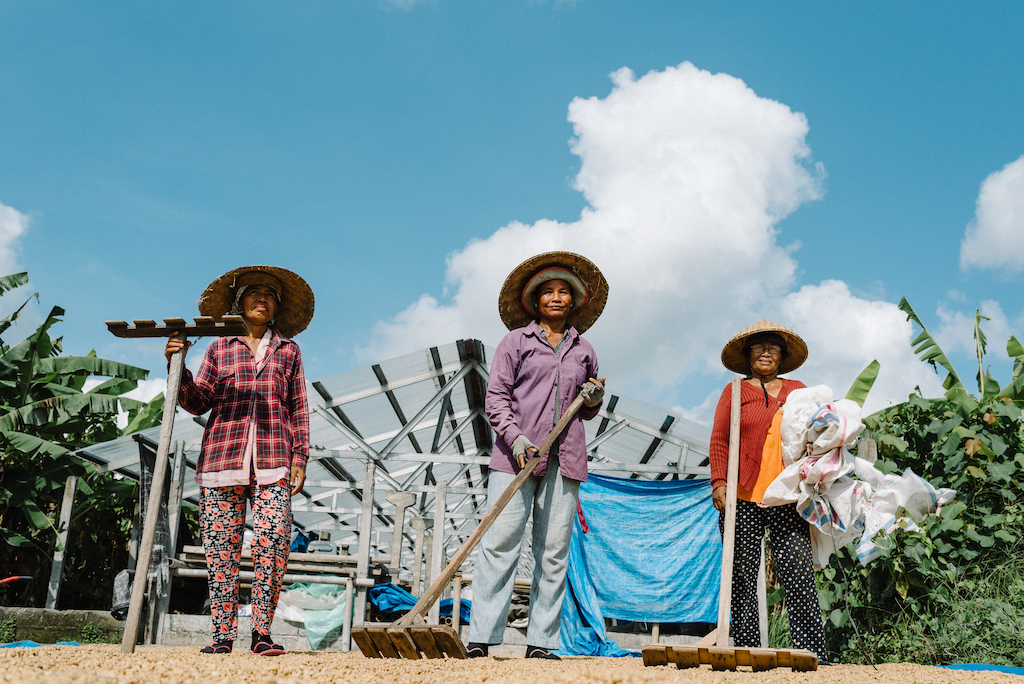
‘BALI COFFEE ORIGIN’S NEW WAVE’ is available through leading book stores in Indonesia
Words: Richard Horstman
Images courtesy of the photographers.
Follow Richard on Instagram @lifeasartasia
*No part of the written content of this website may be copied or reproduced in any form, along with article links uploaded to other websites, for any commercial purposes without the written permission of the author. Copyright 2024
 life as art asia