
Artificial Intelligence powering 3D printing technology offers vast new horizons for artistic experimentation.
New media art is a category that challenges fixed categorization. A genre in a continual state of fluidity, as new technologies evolve, human curiosity naturally responds, and artists explore. New media art encompasses all forms of contemporary art created, altered, or transmitted using new forms of technology. This includes digital art, interactive art, internet art, virtual art, and art made using AI, robotics, video games, biotechnology, 3D printing, and computer animation.
Emerging Balinese artist Jemana Bayubrata Murti recently began experimenting with new media art. However, his transition into this exciting new domain did not start in Bali but Singapore. From 2016 until 2020, Murti completed a Bachelor’s degree in Fine Arts, graduating with First Class Honours from the Nanyang Academy of Fine Art in Singapore. His curriculum included the one-year subject, New Media Art.

2 A close-up inspection of ‘Phantom’ reveals the finely textured surface from the Polylactic Acid 3D printing process within the contoured AI configured composition.
“I had been using an IPad for digital art and sketches before attending NAFA. The subject opened my perspective to new ideas using advanced software programs,” Murti told the Jakarta Post. While at NAFA, he learned that a computer is a tool to use to his advantage to develop his practice.
“Returning home to Bali after four years away so much felt different. I was observing the island through a new lens, highlighting my culture’s vulnerability. I recognized issues relevant to cultural responsibility. For example, many Balinese families have gamelan instruments at home. Yet, they are enticed to sell this icon when they are without money. This raises questions.”
“What state should this cultural object take? Is it ok to sell the gamelan for money because if they don’t sell it, they are unable to eat? If the object is sold to a foreigner, it may be taken out of Bali, resulting in the loss of the object. Yet if the object is kept, the people remain hungry,” Murti stated. “This problem triggered ideas, and if the Balinese no longer honour the responsibility of maintaining their culture, what would happen if we bestowed this obligation upon machines?”
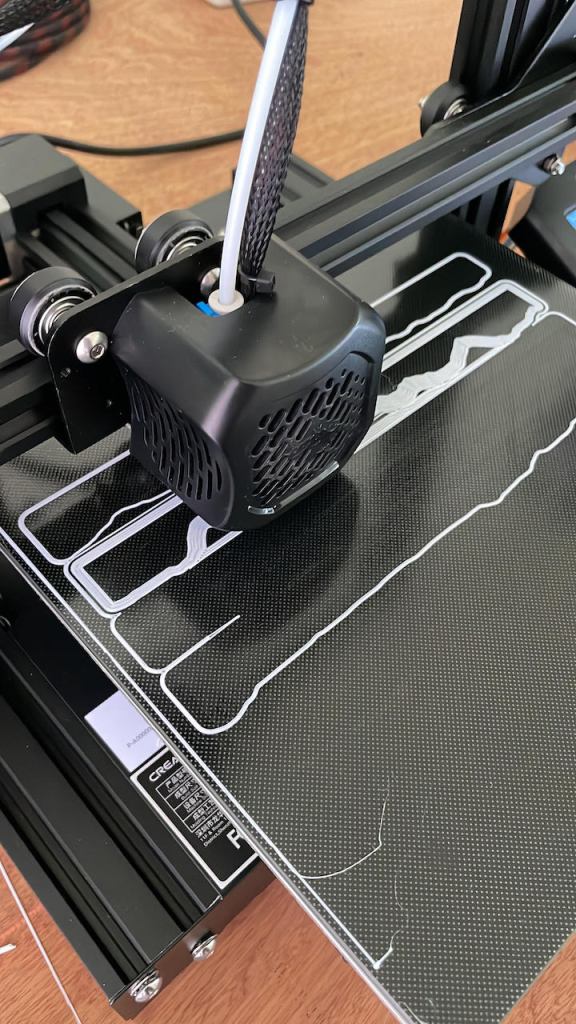
Murti’s three 3D printers collectively consumed 506 hours in printing ‘Phantom’
Murti expresses his creativity via textured abstract paintings and sculptures formed with hardened fabric and polyester resins. His works are imbued with Balinese philosophies, often utilizing ash in his works as a symbol of the eternal cycles of life and duality. “While ash represents the end of life, ash is also used as a fertilizer to renew life. From something so dark and pessimistic like death, ash, also represents new life and evolution,” he said.
In 2022 Murti discovered an online AI learning program that, fed a string of words, will study the terms, find images on the Internet, and devise corresponding images. In August, he began his using the program and 3D printers employing bioplastic, Polylactic Acid made from sustainable sources of fermented sugar cane, corn starch and cassava. “This AI program is like a way for machines to perceive culture,” Murti explained. “For example, if we post images of Balinese wood carvings online, the AI will study them and invent their version. I am very interested in this methodology and the new AI culture.”

A close-up inspection of the 3D printing in process.
By examining ‘Balinese Carvings,’ the program developed an array of images. One was selected and fed into 3D printers, creating 20 x 20 x 3 – 4cm pieces Murti amounted together upon an aluminium frame. ‘Phantom’ is an imposing composition with a black graphite lustre. Abstract in nature, the composition features random flowing patterns reminiscent of Balinese Patra floral designs. The surface is deeply textured, like a volcanic landscape carved into plastic. ‘Phantom’ is the first in a series of works entitled ‘Ghosts from the Future’.
“This work came into existence using machine learning technology as my eyes and 3D printers as my hands. It reveals a glimpse of a bleak alternate future. ’Phantom’ is my representation of what Bali may look like when technology increasingly eradicates traditional culture. Where the Balinese abandon the ways of the past and machines slowly replace us as custodians of the culture. ‘Phantom’ exists akin to a ghost from the past.”
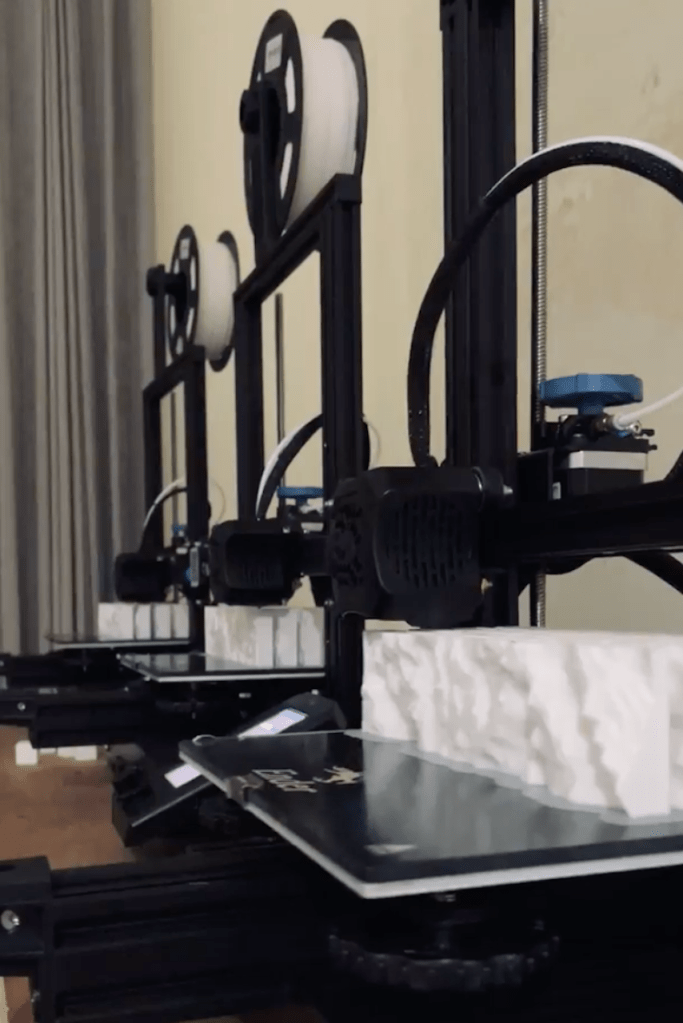
Murti’s 3D printers with reels of Bioplastic in his Denpasar studio.
“’Phantom’ is a proclamation of a dilemma which must be identified and presented. It is an embodiment of an existing problem and even without it the problem exists and the Balinese would continue unconsciously incorporating technology into their culture. We so often close one eye to the dire contradictions we encounter. ‘Phantom’ reminds us of our responsibilities.”
Murti’s follow-up work ‘Mirage’, 80 x 60cm, has a profile similar to ‘Phantom’, yet is distinguished by a brilliant gold leaf overlay. “A mirage is an event where we see things that should not be there. Like seeing a ghost, yet in a different form. The gold is an imitation of desert sand sparkling under the radiant sun where we would most likely encounter a mirage,” he said.

Murti’s follow-up composition ‘Mirage’ featuring Gold gilding on 3D printed Polylactic Acid Bioplastic.
“The material I use is technically plastic, the opposite of wood used for carvings. Method-wise, the printers add materials rather than the traditional technique of removing material. Most importantly, the Balinese imbue their soul into their art when making carvings. Robots merely run programs.”
“I feel the human spirit is not the only thing that attracts us to art. To me, it’s the artist’s questioning that’s compelling. Can an artwork be thought provoking even when there is no spirit? And, can automation be interesting when everything that comes out of it is one of a kind? For the most part, art has always been about the artist’s spirit or the inclusion of the spirit in the art. However, the absence of that is just as interesting.”
Words: Richard Horstman
Images courtesy of Jemana Murti
Follow Richard on Instagram @lifeasartasia
*No part of the written content of this website may be copied or reproduced in any form, along with article links uploaded to other websites, for any commercial purposes without the written permission of the author. Copyright 2024
 life as art asia