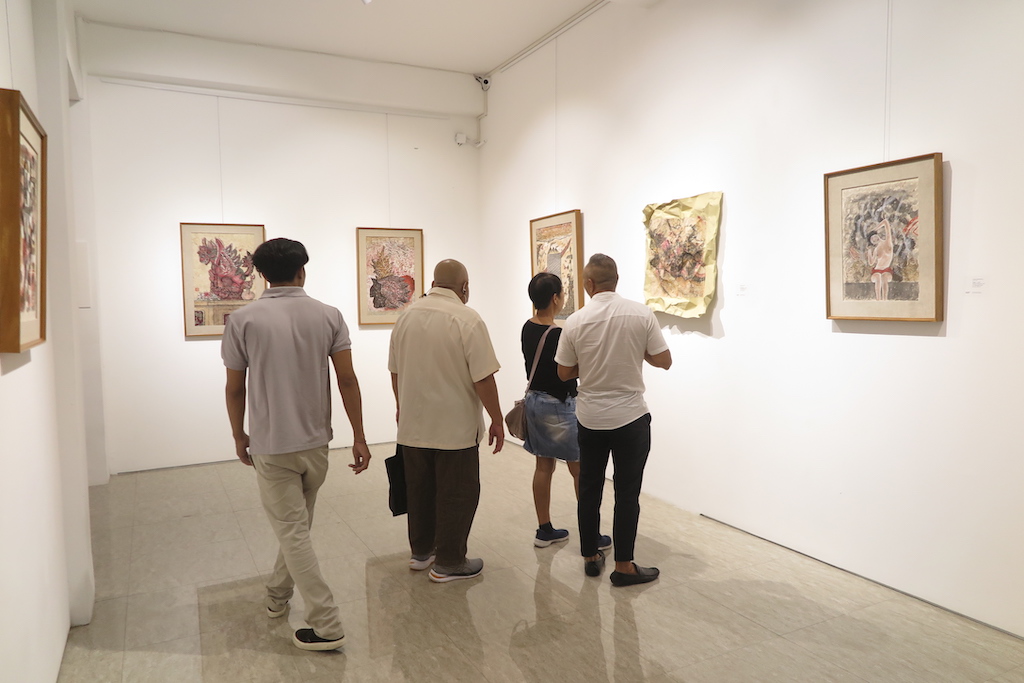
Colour intricately unifies the magnitude of the Balinese culture. Superb and charismatic, colour defines the visual experience. Sacred traditional knowledge confirms colour as an essential aspect of the artistic, aesthetic and symbolic culture, value-rich with philosophical import. The vital interrelationships are mapped precisely within the Balinese Nawasanga or colour mandala. Complete cultural intelligence, from the physical to the non-physical realms, is linked within this natural universal system.
A landmark presentation and a cultural highlight of 2022, ‘Warna Bali: Natural Balinese Colors in The Contemporary Art’, opened in Kuta, Bali 15 October. The exhibition has two components, the results of Balinese colour research and creations of Balinese colour development by thirteen contemporary Bali artists. The event, which continues until 15 November 2022 at the new Gala Rupa Balinesia Art Space, celebrated the establishment of a new art foundation in Bali, Yayasan Gala Rupa Balinesia. The foundation’s objective is to establish a center for new Bali art in Ubud.
The participating artists are Tjandra Kirana, Chusin Setiadikara, Nyoman Erawan, Wayan Sujana, Wayan Redika, Made Wiradana, Made Griyawan, Ketut Suwidiarta, Dewa Ratayoga, Wayan Suja, Nyoman Rediasa, Ni Nyoman Sani and Osbert Lyman.
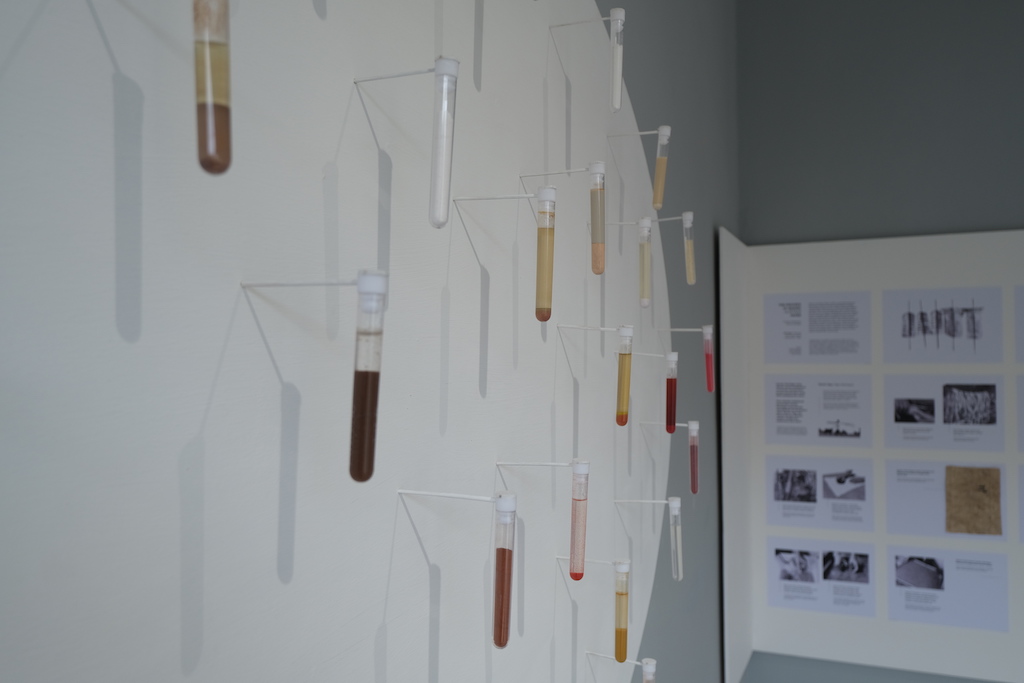
Examples of some of the 31 Natural Balinese colours and exhibition information on display at Gala Rupa Balinesia Art Space.
“Color as an artistic medium is historically rooted in the traditional practice of visual culture based on Balinese religiosity”, writes curators Wayan Seri Yogaparta and Made Dwitayana in the exhibition catalogue. “Until now, the technical and knowledge systems of colour have remained limited to certain sangging.” (traditional collectives sponsored by the royal patronage responsible for creating all sacred ritual artefacts and objects, including the performance masks, wayang puppets and Classical paintings). “There has never been an attempt to formulate this cultural capital into a science that includes media (materials, techniques) and philosophical concepts.”
In June 2021, the Gurat Institute, the research division of Komunitas Budaya Gurat Indonesia, began collaborating with the Gala Rupa Balinesia Foundation to research and document the most up-to-date comprehensive knowledge system on Balinese colour. The research findings were then cross-examined with the existing documentation and literature, becoming the basis of an initiative by the Gurat Art Project, a division of Komunitas Budaya Gurat Indonesia focussing on curation, events and art program organization, and producing artworks. Balinese colour has its own technical aspects and characteristics with natural materials, and the visual effects are very different from the modern synthetic colours.
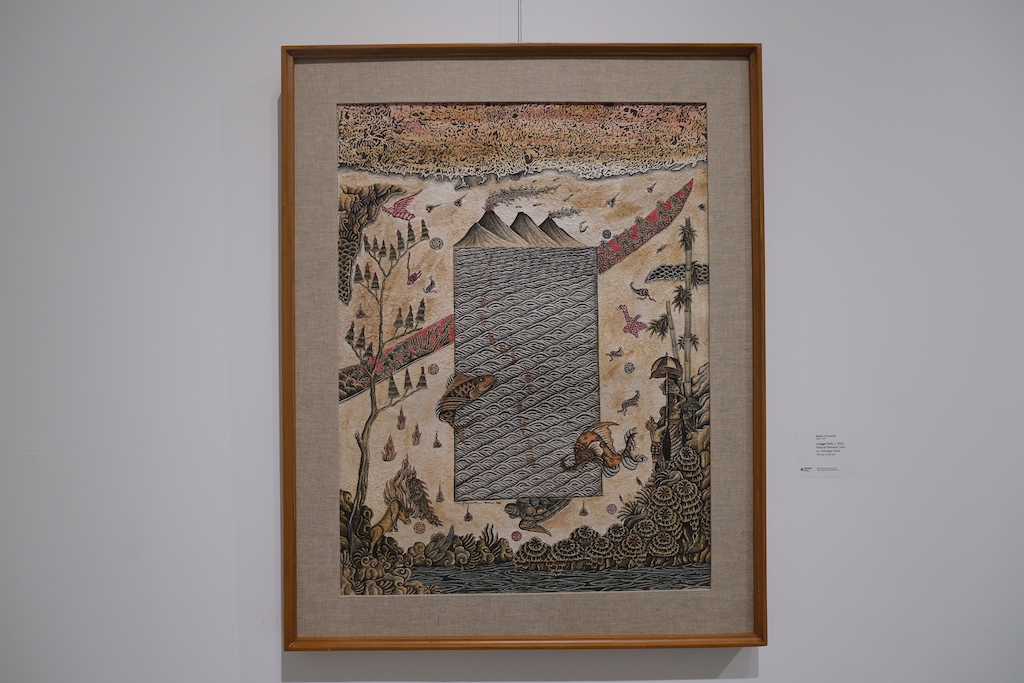
‘Lingga Yoni’ 2022 – Made Griyawan. Natural Balinese Colors on Ulantaga Paper, 79 x 59 cm.
The participating artist’s current practices had no relation with the traditional techniques and knowledge system and were challenged to create artworks on Ulantaga (Daluang) mulberry tree paper made from traditional techniques as the medium. The paper has different absorption properties to modern paper and raises technical challenges. Five natural base colours were used, pig bone powder as a white pigment, soot or mangosteen as a black dye, Gincu (Cinnabar) as a red dye, Pere stone a yellow hue, and blue from Taum (Indigo) leaves. These bases produce distinctive color characteristics used in traditional sacred works, such as wayang kulit, performance masks, Classical wayang, or Kamasan painting.
The inclusion of one of the leading contemporary pioneers of the traditional Batuan painting style Made Griyawan is significant. While the artist had to modify his method of colour application the textural qualities of the paper enhanced his style. ‘Lingga Yoni’ 2022 resonates deep visual tones reminiscent of the original 1920s Batuan paintings when the thematics emphasised duality, and the light and dark aspects of the human experience. “This experience led me to a deeper understanding of the Balinese colour philosophies,” Griyawan told the Jakarta Post.

Komunitas Budaya Gurat Indonesia head curator Wayan Seriyoga Parta and exhibition attendees during the Warna Bali opening 15 October.
“I responded to paper colours, textures and antiquity with a monochromatic figurative drawing with a refined use of red,” said Ketut Suwidiarta of his composition ‘Rajah’ 2022. Rajah is the alphabet of symbols associated with mystical ritual objects and art. Suwidiarta invents his own expressive symbolic language and excels with this work.
Senior artist Chusin Setiadikara is noted for his realism paintings of the highest technical standards. ‘Pose’ 2022 juxtaposes the power of subtle figurative lines of a partially naked woman against a background of pulsating movement. Modified Classical Balinese rock icons marry with dynamic grey, light blue and red abstract brush strokes highlighted by the paper’s sensuous fibres. The composition is anchored in the lower portion by a span of black functioning as the subject’s seating. The visual formula cannot be faulted. The work contrasts elegance against chaos and motion alongside stillness.

‘Heritage’ 2022 by Wayan Redika reveals the artist can achieve results with natural colors which are compatable and beyond using synthetic materials.
Nyoman Erawan’s abstract expression ‘Suklapaksa’ 2022 captures a refined and reserved example of his creative power. ‘Kresnapaksa’ 2022, however, is distinguished by the artist crumpling the paper and presenting its aesthetically attractive valleys and peaks as a three-dimensional artwork. Significant feedback comes from Indonesian Arts Institute (ISI) lecturer and renowned artist Wayan ‘Suklu’ Sujana. “I describe the expressive sensations of working with the natural materials as an inner conversation between the paper, brushes, colour and myself as an artist,” he told the Jakarta Post. “I experienced deja-vu, feeling what the undagi, (traditional master architect), sangging, and citakara (sacred painting specialist) did in the past creating works for communal presentation.”
“Initially, I studied and sensed the properties and characteristics of the colours, their density and transparency. However, achieving strong colour coverage was difficult due to the paper’s absorption qualities. Finally, due to several failures, I found an appropriate method for my style,” said Wayan Redika, a master technician of extraordinarily detailed and precise compositions. ‘Heritage’ 2022 reveals he can achieve his usual excellent standards. “The nature of the Balinese color, especially white from the bones, is the solution making it easier for me to work. White is able to mix with other colours to form a shiny new colour with the density I desire.”

Examples of the beautiful Ulantaga natural paper made by Aryatama Nugraha on display. Image Richard Horstman
‘Warna Bali’ pushed the artists into new technical and creative territory. The outcomes represent a historical breakthrough in Balinese contemporary art. Furthermore, the initiative represents the beginning of a new momentum to reinvigorate colour practice and knowledge within contemporary Balinese art creation and discourse.
Two significant aspects anchor the exhibition. A small room displays sacred communal art historically linked and animated by Bali colours; topengs, wayang puppets and a Classical painting. Also presented are two 30-minute documentation films. The first is about research documentation containing data findings related to the use of Balinese colours in traditional art works complimented by reviews and opinions from the Gurat Institute team. The next film features statements about the art project by curators and participating artists.

Senior Bali artist Chusin Setiadikara’s wonderful composition ‘Pose’ 2022 55 x 39cm was a highlight of the Warna Bali exhibition. Image Richard Horstman
A display of colour and paper raw materials with supporting information and photographs is the focus within another room. Samples of 31 different natural colours created by local ingenuity and the four different pieces of the beautiful handmade traditional paper are also displayed. A special mention of praise must go to Aryatama Nugraha the creator of the paper.
Excellent display lighting enhances the works sensual attributes. The natural pigments within the paint and paper and the paper’s fibre vibrate with a noticeable life force. Ample vertical space within the building offers perfect viewing potential. The gallery’s design features heighten the feel-good qualities and therefore, the overall appreciation.

Traditional sacred art featuing natural Balinese colours with the documentation video display. Image Richard Horstman
‘Warna Bali: Natural Balinese Colors in The Contemporary Art’ is distinguished by its glowing atmosphere – a unique experience beyond what is plain to see. Beautiful visible and non-visible sensations invigorate the visitors upon entering the gallery. The spirit of human creative endeavour imparted within the natural art materials manifests in a heart-warming ambience that cannot be achieved by using modern synthetic materials.
Words: Richard Horstman
Images courtesy of Gurat Art Project
Follow Richard on Instagram @lifeasartasia
 life as art asia