
Daniel Kho is an international artist who has forged a uniquely contemporary Indonesian art voice. His artistic world brings to life an array of fantastic creatures; travellers through time and space. Described in a multitude of colors and forms, Kho’s iconography reflects the infinitely creative universal life force.
Articulating himself in various mediums in two and three-dimensional forms, Kho unites Eastern and Western influences into an aesthetic language easily recognized as his own. Javanese traditional influences merge with Tribal, Pop and Abstract Art expressions and his otherworldly ideas. The outcome is refreshing; his imagery is vibrant and eccentric. Kho’s characters resonate with light-hearted charm.
Cultural Origins
Born in 1956 in Solo, Central Java, Kho’s parents were Chinese Indonesian. His childhood cultural environment was described by the Surakarta and Yogyakarta royal palaces, that fused Islamic, Hindu and Buddhist influences with remnants of the Dutch colonial past. Before modernity spread across the Nusantara archipelago, ancient mysticism and mythology were fundamentals of daily life. In Central Java, the heart of traditional Indonesian heritage, the storytelling culture of the Wayang Shadow Puppet theatre entertained and informed society.

The Wayang language of symbols and characters, which amongst many narratives describes how people co-exist with the forces of nature and the universe, has greatly influenced Kho’s paintings, sculptures, and installations. Batik textiles are another prominent cultural attribute and visual language, co-existing side-by-side with Wayang. Initially worn for ceremonies, Batik, like the Wayang, functioned as a sacred symbolic bridge between the supernatural world and the physical plane inhabited by humans. During his teenage years in the 1970s, Kho learned the techniques of batik-making and sculpture. Then, as his drawing skills developed, he taught himself to paint.
New Horizons
Kho’s creative journey introduced him to foreign lands. Relocating from Indonesia to Germany in 1977, he received a scholarship from the Jacob Eschweiler Art Foundation the following year. From 1999 until 2006, Kho taught art and performance as part of the MUS-E Artists in Schools’ program organized in Germany by the Yehudi Menuhin Foundation. In 2002, he founded the ‘Shadow Theatre Kho’ in Cologne. Then in 2009 he initiated with friends Djagad Art House in Bali. Since 2012 Kho has lived and worked between Ubud, Bali, Barcelona, Spain and Cologne, Germany. During his career he has exhibited in numerous group and solo shows in Germany, Spain, Belgium, Hong Kong, South Korea, Thailand, Singapore and Indonesia.
Creative References
Multiple cultural sources appear throughout Kho’s oeuvre. For example, a Buddhist prayer wheel and traditional Indonesian architectural features have been the basis of sculptures and installation works. The Kayun, the Javanese representation of the tree of life, is a predominant symbol that informs his sculptures. His multi-coloured and patterned images reflect the vibrant Batik designs. The Chinese dragon has also been a popular theme. In addition, simplistic figures and symbolic marks mimic ancient cave paintings and tribal art. The flowing, delicate graphic outlines that define his iconography are technical attributes of the sacred Hindu Wayang paintings.

‘On the Planet Nareti’ 2008-2009, is a wooden relief carving in which Kho draws from the magnificent stone relief carvings that decorate famous Javanese shrines; the Hindu Prambanan temple in Yogyakarta and the world’s largest Buddhist monument, the Borobudur in Magelang. Kho moves between different media. He explores creative possibilities within his 3-dimensional works with fibreglass resin, wood, leather, sheet metal, granite and Paras stone carved from Indonesian river banks.
Kho’s Colour Domain
Javanese mystical teachings reveal that human beings are multi-dimensional and are not bound to this physical world. Instead, our spiritual life force permeates the universe. Kho’s eccentric Pop Art colours reflect the vast creative essence of the cosmos. Combinations of primary and secondary colours and variations of lighter tones and darker shades describe Kho’s colour schemes. In addition, he juxtaposes red with green and yellow with blues, adding dramatic visual tension to his works.

Kho’s occasional use of fluorescent glow in the dark paint, dazzling oranges, yellows, greens add another energizing dimension to his work. The images, displayed in darkened rooms alongside fluorescent globes, burst into life with luminous psychedelic properties emphasizing their cosmic qualities. The black graphic outlines that describe Kho’s designs contribute to the visual contrasts. The lines entertain our eyes as we traverse the canvas in a journey of discovery—our attention shifts back and forth from the black line to his dynamic colour schemes.
Recent Progressions
Negative spaces within a painting are the subjects’ contrasting areas (the positive space). They are fundamental to defining the form of the subject and are a notable new aspect of Kho’s work. The negative spaces highlight the strength of the beautiful curving contours and straight lines that define his iconography. The negative spaces may appear complete with plains of rich colour or rendered in contrasting colours, applied with dynamic abstract brushstrokes.

The circle has no beginning and end. It represents eternity, completion, vitality and perfection. It signifies an evolution from birth to death and the continuation of life, as described in the Hindu belief of reincarnation. A circle symbolizes the Divine spiritual life force. A new feature in Kho’s pictures is large circles which become the defining forms for his unusual characters. At first glance at the painting, the circle’s perfect symmetry immediately captures our eye. The precise geometry resonates with frequencies that stimulate the subconscious mind.
Equilibrium
While some of Kho’s earlier compositions are overwhelmingly busy, a new feature of his larger pictures is reduced iconography. His objective is to emphasize the negative and positive spaces and highlight compositional balance. As a result, the images are more harmonic and feel easier on the eye. According to Kho, equilibrium has an important symbolic role. Hinduism states the universe comprises two equal and opposing forces; therefore, we must balance these dualities to find harmony. Kho intentionally represents an array of opposites as a metaphor for life. Buddha said we must seek the middle path in life.
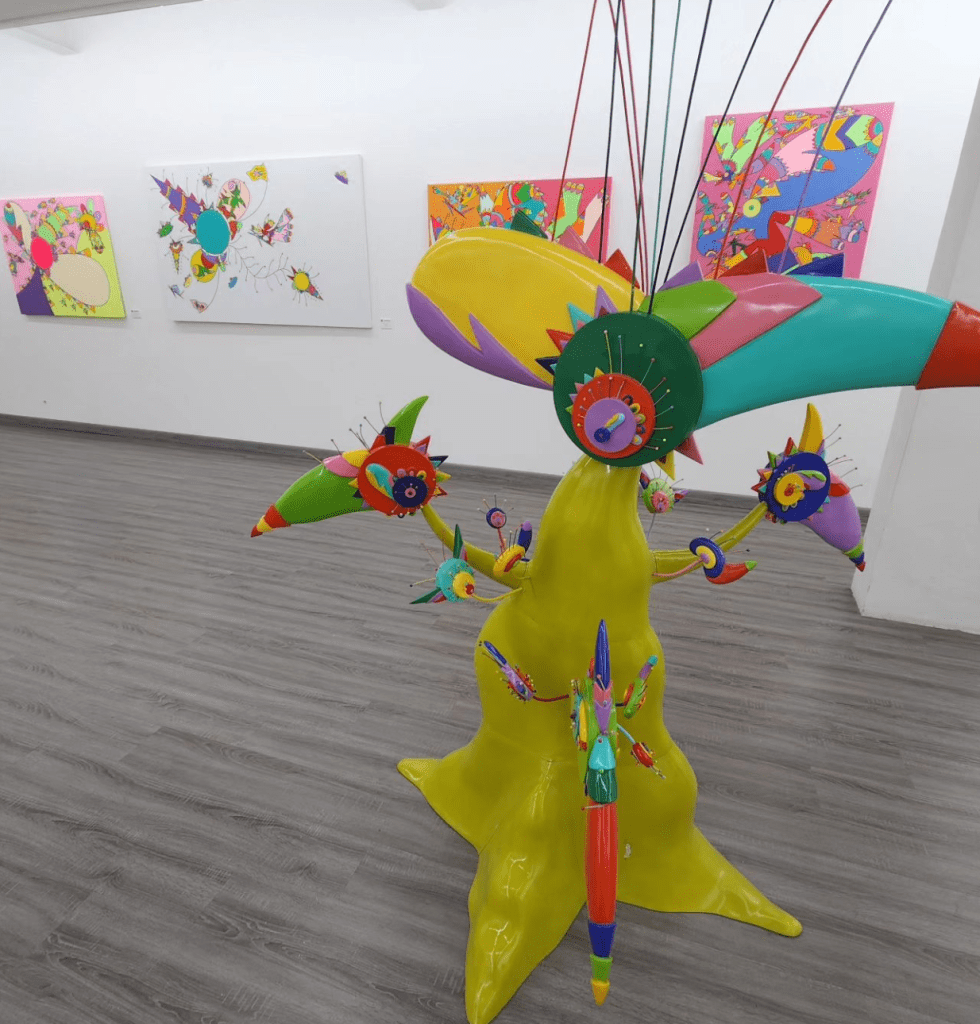
‘Dunia Aku’
In ‘Dunia Aku’, Daniel Kho exhibits over fifty paintings, sculptures and installations to amuse and delight our curiosity. He offers us a unique visual language of the micro and macrocosm, yin/yang and the upper and lower world relationships for us to contemplate. Kho inspires us to connect with our infinite, universal self, and to imagine possibilities beyond the limitations of the 3-dimensional world.
Words: Richard Horstman
Images courtesy of Daniel Kho
Follow Richard on Instagram @lifeasartasia
No part of the written content of this website may be copied or reproduced in any form, along with article links uploaded to other websites, for any commercial purposes without the written permission of the author. Copyright 2024
 life as art asia