
Traditional Balinese culture offers the global community insight into how people cocreate in union with nature’s multi-dimensional forces. Foreigners may believe otherwise because Western culture has an opposing viewpoint; the Old Testament of the Bible taught that God made humans in his image with dominion over the Earth. These values are the foundations of modern anthropocentrism, a belief system stating humans as separate from and superior to the nonhuman world.
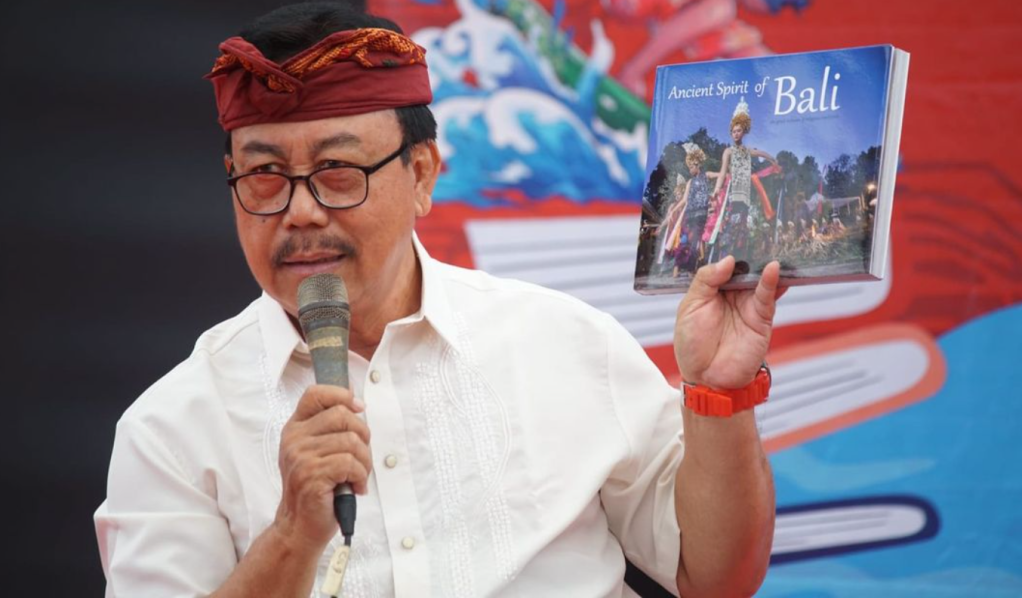
‘Ancient Spirit of Bali – the great richness of religious traditions, is a beautifully illustrated two hundred-and-twelve-page book with the visual emphasis upon photography by Ida Bagus Putra Adnyana. The extraordinary endeavour by the specialist in documenting exceptional and unusual sacred rituals is complemented by lengthy captions by the renowned cultural wordsmith Garret Kam. The book ventures beyond the normative borders of investigation, revealing antiquated traditions rarely witnessed by the Balinese.
Sacred Balinese ritual is a fantastic realm. Wonderfully colourful, vibrant and dynamic. It is immediately exotic and mysterious for the inexperienced, unravelling the island’s cultural layering and being introduced to the rich and complex culture afresh. A multifaceted merging of animism and ancestor worship with Buddhism, Hinduism and old folklore. Never static, Balinese culture is fluid and constantly integrates external influences.

The essential volume, a window of deep knowledge of an extraordinarily visual culture is published in hardcover by MPB Publishing in early 2022. It features over two hundred colourful digital photographs by the award-winning photographer and former photojournalist who has widely exhibited nationally and internationally with work featured in numerous books. Ida Bagus Putra Adnyana, alias Gustra, began documenting his culture over forty years ago and arguably has the biggest visual documentation on Bali in the world (12 plus terabytes) and of the highest quality. Museums should compete with one another to include them in their collection.
It’s likely, you have already seen Gustra’s images in hardcopy print or online. Still, you are yet to know the creator behind the lens. Born in Denpasar in 1958 into the priestly Brahmana caste, Gustra’s initial cultural learnings coincide with his father, a specialist in the sacred magical drawings, rerajahan. The youth’s challenge was to perfect the many designs encompassing symbols, script and pictures required to empower the white cotton shrouds adorning the deceased’s body in preparation for cremation. Gustra excelled and wanted to become an artist. However, his father insisted he study law. Then, in his early twenties, he was gifted his first camera and had been capturing and storing thousands of images each year.

Gustra presents his photographs in ‘Ancient Spirit of Bali – the great richness of religious traditions’ within seven categories. Rituals in the major populace centres are included. However, most of the groundwork in compiling the images occurs in the remote mountainous regions of north and eastern Bali in the Karangasem regency. The book also highlights rare and unusual fertility ceremonies and offerings of the Bali Aga people in Tengannen and Truyan villages. Some of the few who resisted cultural integration with the invading forces of the East Javanese Majapahit Empire during the 14th century. The fantastic forms in which the offerings take shape and the ceremonial costumes boggle the mind. They are a testament to creation possible only through divine invention.
What distinguishes this book from other documentations of Balinese rites and rituals is that Gustra has unique experience being a custodian of exclusive knowledge passed down through his high caste Brahmana lineage. His right of entry to information about events, allows direct access to the most sacred Balinese traditions.
‘Ancient Spirit of Bali – the great richness of religious traditions’ chapters begin at the source of life, in ‘Holy Water – Flower Power – Purifying Flames’. Next follows ‘Spiritual Orientation of Mount Agung’, ‘Agricultural Rites’, ‘Sacred Masks’, ‘Rejang and Baris Dances’, ‘Back to Nature’ and culminating with ‘Rituals Before Saka New Year’. Composed by the most qualified foreigner to write about Balinese sacred ceremonies, Hawaiian-born Garret Kam received his Fullbright grant in 1987 to study Balinese rituals. He has curated numerous national and international exhibitions on Balinese culture and has written many articles, catalogue essays and books.
Ida Bagus Putra Adynana
Kam states the distinctiveness of these century-old traditions may be accounted to the people’s remarkable preservation of ancient heritage before the coming influences of the East Javanese Majapahit empire. Noting the most important female performance, the Rajeng dance, Kam reveals that many of the dancer’s headdresses adorned with stunning flowers are similar to those worn in parts of Polynesia.
A fascinating double-spread image illustrates pages 154-155. Beautifully dressed Rejang dancers, holding onto their leading counterparts’ white sash, circumnavigate an enormous rice flour figure of Yamaraja, the Hindu god of the underworld. Text notes that after completing their performance, the audience rushes to collect the powdered rice with earth to treat skin diseases. Gustra has recorded one-of-a-kind ritual merging religion, dance, installation art and traditional healing.
One of the oldest sacred mask traditions and rarely performed rituals of Trunyan is the barong berutuk fertility performance. The dancers adorn an unusually photogenic costume, with opposing aesthetics to the customary magnificently detailed attire, featuring dried banana leaves and simple primitive masks. Another rite pictures a performer wearing a gold mask believed to date from the 14th-century East Javanese Majapahit kingdom. Underlining the significance of Gustra’s cultural endeavour is the image of the topeng dedari dance performed by two pre-pubescent girls. He photographs a cleansing ritual last performed 200 years ago and was done again in Sukawati during the pandemic to cleanse and harmonize the universe.

Baris Memedi (Spook Warriors)
Bringing together such a compilation of images captured over a 20-year period, some taken during the pandemic, into one coherent photographic essay is an extraordinary feat of dedication. Gustra’s acute sensitivity immortalizes irreplaceable snapshots in time and warrant the highest praise. The images documents alchemic customs transforming energies of the sacred elements of fire, water, wind, earth and ether with other powers to procreate and sustain life.
Essential for cultural connoisseurs and the curious, ‘Ancient Spirit of Bali – the great richness of religious traditions’, endorses the Balinese as proud custodians of a rare and magnificent culture with an inclusive universal perspective inspiring awe among the people and outsiders. Their ingenuity and creativity are a unique gift to the global community. The document confirms the Balinese in unison nature and the cosmos while elevating our cultural appreciation to a new plateau.
Words: Richard Horstman
Images courtesy: Ida Bagus Putra Adnyana
Instagram: ib_putra_adnyana
Follow Richard on Instagram @lifeasartasia
No part of the written content of this website may be copied or reproduced in any form, along with article links uploaded to other websites, for any commercial purposes without the written permission of the author. Copyright 2024
 life as art asia