
By default, Dutch portrait specialist Willem Gerard Hofker arrived in Bali, the Dutch East Indies, in 1938. During the 1930s, Hofker (1902-1981) shot to fame, becoming a portrait painter in great demand by Dutch society. As a result, the artist and his wife, Maria, were invited to travel the archipelago aboard a Royal Dutch Steam Packet Company (KPM) liner making paintings and drawings reproduced for a KPM advertising campaign.
Impressed by the Balinese culture and the beautiful Legong dancers, Hofker set to work on a series of oil and pastels describing elegance as seen through a foreign artist’s eyes. Some compositions highlighted picturesque scenarios during temple ceremonies. Others focused on temple offerings and the dancer’s costumes. Some described casual poses revealing extraordinary, feminine beauty. Hofker went on to complete hundreds of works, spent time as a Japanese prisoner in Makassar during WWII and finally returned to the Netherlands in 1946. Indonesian modern art collectors prize his iconic interpretations of Balinese women.
‘Ni Sadri, Legong Klandis‘ 1938, a large 92 x 66.5 cm, rare Hofker oil on canvas masterpiece of the legong dancer Ni Sadri is among the highlights of the sale ‘Exclusive Items’ 23 November 2021 by Zeeuws Veilinghuis – Zeeland Auctioneers, the Netherlands. The remarkable work has solid provenance, is in excellent condition including individual photos of Hofker and the artist’s niece Seline with the picture. The artist has signed the upper right corner ‘W.G. Hofker. Illustrated in its hand carved wooden frame in ‘Willem Gerard Hofker ‘(1902-1981, by S. Hofker & G. Orsini, Publisher De Kunst, 2013, p. 159 ill. 206 and on p. 232 ill. 367), the work has an estimated value of between € 250.000 – 350.000.

W.G. Hofker in his (ATELIER) studio in Amsterdam, 1953 with the Ni Sadri painting in the background. Image courtesy of the Hofker Archive & Seline Hofker
In 2000 Seline Hofker started gathering letters, diaries and photographs of the Willem and Maria Hofker estate. Her passion for discovering more about her uncle’s life and work evolved into the ‘Hofker Archive’. After a year and a half of intense searching, scrutinizing national archives and family trees, writing numerous letters and talking to many people, she located, identified and correctly documented ‘Ni Sadri Legong Klandis‘ in 2011. Seline’s extensive essay is printed in a separate 12-page booklet beside the auction catalogue and details how the current owner came to purchase the work.
Sadri sits in a three-quarter side view, dressed in a blue sarong and long-sleeved green blouse all with gold prada decorations. Her presence is regal and graceful. The setting of muted beige and browns differentiates the backdrop behind her. Sadri’s form interconnects with the background creating a powerful negative space, one of the highlights of the composition. At times Hofker uses fine black lines to emphasize this relationship. Our attention is drawn to Sadri’s face. Contrasting against the brilliant white frangipanis and golden embellishments adorning the headdress and costume, Hofker aligns her eyes within two circular decorative hangings that appear like blazing stars.

Seline Hofker and ‘Ni Sadri, Legong Klandis‘ 1938 by W.G. Hofker. Image courtesy of the Hofker Archive & Seline Hofker
A refined jawline and nose underscore Sadri’s facial features, while the artist cups her chin in gold. The varying skin tones highlighted in bronze and subtle ochres upon forehead, cheeks and lips of her well-pronounced mouth emphasize her youth. The eyes are round and full; specks of light are reflected upon the surface. Her elongated hands, limbs, and body defy the size of her face yet add strength to her noble character.
Sadri’s left hand has extraordinary long and delicate fingers. The right-hand description reveals the index finger and a slither of thumb. Immediately above her hand is a pulsating dash of green juxtaposed against the golden costume and the vibrant blue sarong. The composition’s unique mix of realism, expressionism and impressionism is captivating. The rhythmic movement of impressionistic and expressionistic painterly elements in her costume draws attention to and emphasizes Sadri’s majestic omnipotent presence. Hofker translates the model’s beauty into an extraordinary image reverberating with life.
‘Ni Sadri, Legong Klandis‘ is one of the largest oil paintings that Hofker made in Bali. Although he worked mainly in conté and pastel mostly +- 30x40cm, he produced primarily small oil pictures. A similar painting, ‘Tjawan and Sadri, Legong Dance’ February 1939, 86.5x54cm, is distinguished by Tjawan’s expression of disinterest and Sadri’s fleeting gaze. The picture’s colours are subdued, and by comparison, however, lacks visual potency.
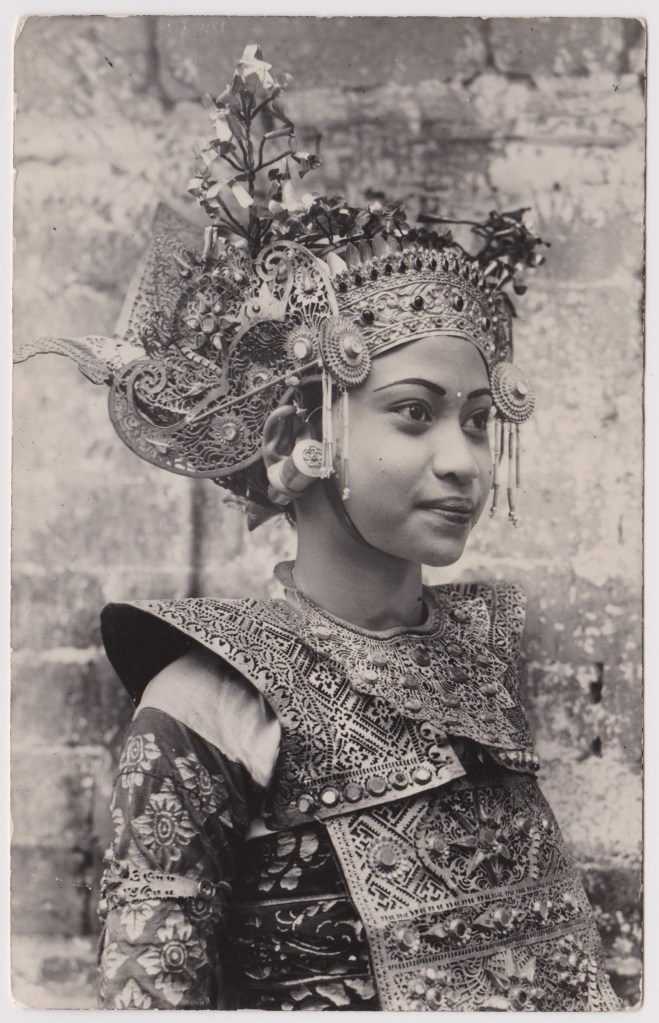
Ni Sadri photo card with Hofker handwriting on the back. Collection of Hofker archive. Image courtesy of Seline Hofker
Seline’s archives record Maria Hofker’s notes about Sadri dated 18 September 1938, “She’s all in gold. Gold leaf on her silk sleeves and sarong and rigged with gilded carabao leather, similar from the wayang dolls, for the headdress and collar.” “Wim has drawn her a few times but is currently painting the dancer in the rich golden dance costume and golden headdress, decorated with fragrant white flowers.There are iron wires and spiral wires on the hood for this, so that the flowers vibrate with every movement. Oh that is so beautiful.”
Of the celebrated artists who immortalized Balinese beauty Hofker is significant for his sensitivity in expressing the pensive longing of his models. A few of his notable works are defined by an angelic innocence resonating within enormous round eyes. Hofker reveals a window into their souls. This sale is a once in a lifetime opportunity for connoisseurs to purchase a museum standard painting for its rarity and quality. ‘Ni Sadri, Legong Klandis‘ will likely break the world record price for a Hofker painting sold at auction.
‘Ni Sadri, Legong Klandis‘ 1938 – W.G. Hofker
Auction date: 23 November 2021
Zeeuws Veilinghuis – Zeeland Auctioneers, the Netherlands.
Words: Richard Horstman
Images: Courtesy Zeeuws Veilinghuis – Zeeland Auctioneers The Netherlands,
Seline Hofker, and the © ‘Hofker Archive’.
This article was published in the Jakarta Post 19 November 2021
You may follow Richard on Instagram: lifeasartasia
 life as art asia