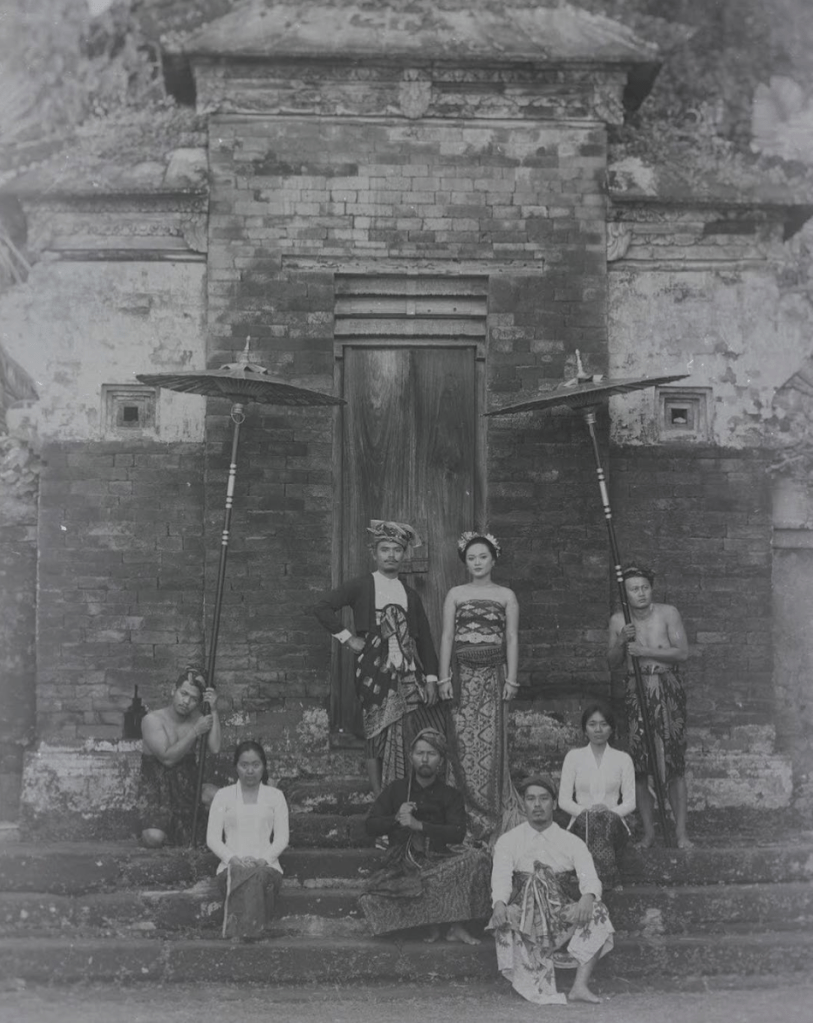
Black and white photographs are making a resurgence within the ocean of Bali imagery circulating in cyberspace. Compelling pictures of yesteryear, describing the people and landscape, ignite nostalgia. Foreigners often yearn for ‘real Bali’, the pre-colonial era when the island was without modern influences. There is, however, a growing sentiment within the Balinese seeking change and a return to the wisdom of the past.
Balinese photographer I Gusti Agung Wijaya Utama S. Sn is a change-maker who endeavors to reignite cultural memory while inspiring awareness and discussion. Gung Ama, as he is known, doesn’t use digital cameras. He believes technology and the modern mindset are destroying the art of photography. He prefers the manual, handmade processes of the past. His instrument of choice is the Afghan Box Camera.
Also referred to as the street box camera or kamra-e-faoree, the Afghan Box Camera is a bulky handmade wooden contraption. It is both camera and a self-contained darkroom. Within the box mounted on a folding tripod, black-and-white photographs are produced within minutes, without film, by making a paper negative and then photographing the negative to create a positive image.

Balinese girl photographed with Afghan Box Camera
“Unlike most Balinese, I cannot draw or paint, neither do I have other artistic skills. My sense of art, however, is very high. Via photography, I can express my talent, learn and grow,” said Gung Ama, Alumni of the Indonesian Art Institute (ISI) Denpasar, majoring in photography. “I have been interested in Afghan cameras since 2019. Yet, I was only able to make my journey of learning through experience happen in 2021. Studying old photography techniques triggered my instincts to wish to experiment in taking these pictures.”
‘Kamra-e-faoree’ comes from the Persian Afghani language Dari, meaning ‘instant camera’. First used in small towns and villages where there were no photographic studios, travelling photographers visited these places and would improvise a studio on the spot. Unfortunately, the box camera is on the brink of disappearing from Afghanistan, replaced by digital photography, modern studios, and smartphone selfies.

I Gusti Agung Wijaya Utama and Afghan Box Camera
“I construct the scenarios for the images either within my studio or outdoors. The subjects are dressed in traditional attire in the studio and sit in front of landscape props and cultural objects to create a coherent old-world ambience. Many young couples are enthusiastic about appearing in photographs of themselves depicted as people from yesteryear,” said Agung Ama, born in Batubulan, Gianyar in 1988, and began photography in 2006. “Outdoor photographs require I look for a specific sight to capture the ideas I wish to express. I also must be sensitive to the natural light and how this may impact the final image. In these circumstances, the outcome is unpredictable.”
Gung Ama’s camera has a shutter lens operated when pushing a trigger connected to the lens by a meter long cable. In the original cameras, the lens is shutterless. The photographer whisks away the lens cap with one hand to expose the photographic paper on the inside of the camera; he then replaces the lid. After the exposure process, Gung Ama inserts an arm through a light-tight sleeve giving him access to the camera’s interior, doubling as a darkroom. Inside the camera, he develops a paper negative of the image he has just taken in a small tray of chemical solution. He then shoots this negative to make the positive image and finally develops the positive to produce a finished photograph.

Yesteryear Afghan Box Camera image of Bali
“The Afghan camera allows me to touch the photos during their development process directly. Increasingly I am becoming sensitized to this process. There is a distinct and special transfer of energy between myself and the work in production,” he said. Gung Ama’s learning is through exploration. He seeks to discover the best methods while experimenting with other chemicals, even coffee, during the image development process, innovating to create novel outcomes.
The first photographs of Bali were taken by foreigners and began circulating in Europe in 1920. The image-making process of tourism promotion developed in the 1930s was often selective and concocted, creating ideas about what Bali represented as a marketing ploy. “Images of bare-breasted women, dancing girls and witches dominated the male eccentric essence of what represented culture.” wrote Adrian Vickers in his book ‘Bali: A Paradise Created’. The idea of Bali as a tropical paradise eventually took hold.

Wayang Wong performance mask photographed with Afghan Box Camera
In 2016 Gung Ama initiated ‘Gamaphoto1930’, with the theme of Rekonstruksi Project Bali 1930 using black and white photographs representing the perspective of the Balinese. “Through these images, I wish to ignite the Balinese people’s sense of curiosity and cultural memories of the past,” Gung Ama explained. “To make people remember the past messages of the elders that are fading with time.”
“The pandemic has granted people time to reflect inward upon themselves and what it means to be Balinese. As a result, there is growing hunger within many of the younger and older generations to seek out cultural wisdom and embrace cultural icons to help reinforce their sense of identity. I wish to contribute to this ongoing dialogue, to inspire people to ask questions and ponder upon culture lost and the wisdom of our forefathers.”

Balinese girl photographed with Afghan Box Camera
Words: Richard Horstman
Images courtesy: I Gusti Agung Wijaya Utama
Instagram @1930studiobali
You can follow Richard on Instagram: lifeasartasia
 life as art asia